Blog
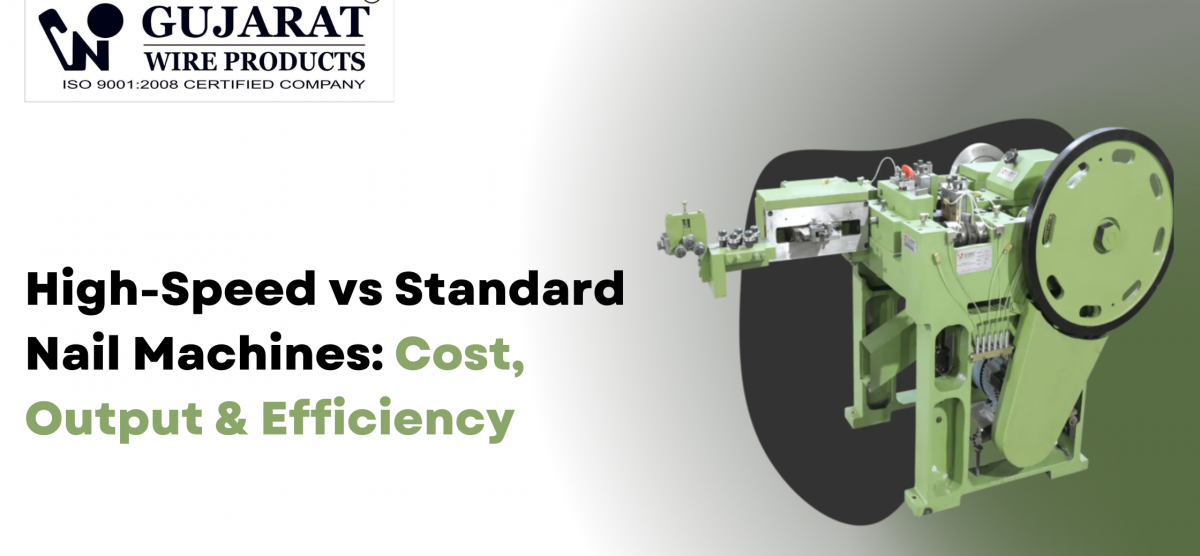
High-Speed vs Standard Nail Machines: Cost, Output & Efficiency
Buyers comparing nail machines almost always default to one question: which one produces more nails per minute? That’s the wrong starting point. A factory running a 300 nails/min standard machine at 85% uptime consistently outproduces a 500 nails/min high-speed machine stuck at 60% uptime. Speed ratings on a spec sheet describe a machine’s ceiling, not its real-world output—and the gap between those two numbers is where most buyers overpay or underinvest. This guide compares standard and high-speed nail machines on the metrics that actually determine your bottom line: realistic output after uptime losses, true cost of ownership beyond the purchase price, efficiency factors like scrap rate and energy use, and which machine type fits which production profile. You’ll finish with a clear decision framework instead of a speed number to chase.
Speed and Output Comparison
Rated speed and delivered output are two different numbers, and the difference matters more as machines get faster.
Standard Nail Machines
Standard automatic machines typically produce 200–300 nails per minute under real production conditions. They suit small to medium operations running mixed nail sizes with moderate daily tonnage, where changeover frequency matters more than peak throughput.
High-Speed Nail Machines
High-speed machines rate at 400–800+ nails per minute, with some rotary systems claiming over 1,000. But real-world throughput typically lands at 65–75% of that rated figure once you account for wire breaks, die changes, and material inconsistencies.
The Effective Output Reality Check
Here’s the uncomfortable pattern buyers miss: model your capacity at roughly 75% of the advertised speed, not the number on the brochure. A machine advertised at 600 nails/min should be planned as a 450 nails/min machine for scheduling and delivery commitments. Buyers who plan against rated speed consistently miss production targets in month one.
Cost Comparison
Purchase price is the smallest part of the total cost equation, but it’s worth getting right first.
Upfront Purchase Price
- Standard automatic machines: ₹6–12 lakh (roughly $8,000–$15,000)
- High-speed machines: ₹12–25 lakh and above (roughly $15,000–$30,000+)
- Precision high-speed models often carry a 40–60% price premium over standard automatic machines
Operating Cost Differences
High-speed machines equipped with VFD-controlled motors consume 40–55 kWh per tonne of nails produced, compared to 70–90 kWh for older fixed-speed standard machines. Labor requirements shift too—standard machines often need 2–3 workers per line, while high-speed automated lines run on 1–2.
Total Cost of Ownership
High-speed machines can reduce per-tonne production costs by 25–35% within the first quarter of consistent operation, once labor and energy savings compound. Standard machines carry lower upfront cost but higher per-unit operating cost as volume scales—the breakeven point depends entirely on your daily tonnage.
Efficiency Factors
Three variables determine whether a machine’s theoretical advantage shows up in your actual production numbers.
Uptime and Reliability
Actual throughput depends more on uptime than peak speed. High-speed machines demand better wire quality and more frequent die maintenance to sustain their advantage—skip either, and uptime collapses faster on a high-speed line than on a standard one.
Scrap Rate Impact
This is the counterintuitive insight most buyers overlook: a factory running at 70–75% of rated speed with under 2% scrap produces more saleable nails per shift than one pushing 95% speed with 5–6% scrap. Speed that generates rejects isn’t speed—it’s wasted wire and wasted machine time. Scrap rate directly offsets whatever speed advantage a high-speed machine claims.
Energy Efficiency
Optimized power transmission and intelligent energy-saving modes cut energy consumption by 20–30% compared to traditional fixed-speed machines. VFD technology delivers this efficiency gain and better output consistency at the same time—these aren’t competing benefits, they come from the same underlying control system.
Product Mix and Flexibility
Machine choice should follow your order pattern, not the other way around.
Standard Machine Flexibility
Standard machines suit small to medium, diversified orders where flexibility matters more than raw capacity. They’re also easier to maintain and simpler to operate across a wide range of nail families without complex tooling changes.
High-Speed Machine Specialization
High-speed machines perform best when a plant runs repeated nail sizes against stable, predictable orders. They lose their advantage fast in environments where product mix changes constantly.
Changeover Considerations
- Standard machines: simpler tooling swaps, lower changeover cost, faster to reconfigure between nail sizes
- High-speed machines: more complex tooling systems, longer changeover time, but significantly higher throughput between changes
When to Choose Standard Machines
Three scenarios consistently favor standard machines over high-speed alternatives.
- Small-scale operations: Daily output below 1.5 tonnes per shift rarely justifies high-speed investment
- Capital-constrained startups: Lower initial investment and simpler maintenance reduce financial risk during the early production phase
- Diversified order profiles: Businesses filling niche market needs where flexibility outweighs raw capacity
When to Choose High-Speed Machines
High-speed investment pays off under specific, identifiable conditions.
- Large-scale production: Operations consistently producing above 3 tonnes per shift
- Stable product mix: Repeated nail sizes with predictable orders and infrequent changeovers
- ROI-focused scaling: Manufacturers who can dilute the higher upfront cost across large, consistent production volumes
Decision Criteria Checklist
Work through these steps in sequence before committing to either machine type.
- Calculate true capacity requirement: Required capacity (kg/h) = (monthly nail demand in kg ÷ 22 working days) ÷ 8 hours × 1.3 buffer
- Match machine to product mix: Narrow, stable product family favors high-speed; diverse, changing mix favors standard
- Evaluate total cost, not purchase price: Include energy consumption, labor needs, scrap rate, and maintenance costs in your comparison
- Assess operator skill and support access: High-speed machines demand more skilled operators and reliable technical support to sustain their uptime advantage
FAQs
Is a high-speed machine always the better long-term investment?
Not for every operation. High-speed machines deliver lower per-tonne cost only when running consistently above 3 tonnes per shift with a stable product mix. Below that volume, the higher upfront cost and maintenance complexity outweigh the throughput gains.
Why does my high-speed machine underperform its rated speed so much?
Rated speeds assume ideal wire quality, zero changeovers, and continuous operation. Real production includes wire breaks, die adjustments, and material inconsistencies that typically bring effective output to 65–75% of the rated figure. Plan capacity using that reduced number, not the brochure spec.
How much does scrap rate actually cost in a high-speed operation?
Significantly more than most operators estimate. A machine running faster but generating 5–6% scrap can produce fewer saleable nails per shift than a slower machine holding scrap under 2%. Every rejected nail also wastes the wire, energy, and machine time that produced it.
Can I upgrade from a standard machine to high-speed later?
Yes, and many operations follow exactly this path—starting with a standard machine to establish stable demand, then adding high-speed capacity once volume justifies the investment. This staged approach reduces financial risk compared to over-investing before demand is proven.
Conclusion
Choosing between standard and high-speed nail machines comes down to your actual daily tonnage, product mix stability, and willingness to manage the operational discipline high-speed production demands. Speed alone tells you nothing about your real cost per saleable nail. Contact us today for a capacity assessment matched to your specific production volume and nail mix.
Gujarat Wire Products supplies both standard and high-speed nail making machines, and we start every conversation by modeling your realistic output—not the advertised speed—against your actual daily tonnage and product mix. We help you evaluate total cost of ownership across energy consumption, labor, and expected scrap rate, so your machine choice is grounded in your numbers rather than a spec sheet. Our team provides installation, operator training, and ongoing technical support to help you sustain uptime once the machine is running. Visit gujaratwireproducts.com or call us directly to get a tailored recommendation for your nail production needs.