Blog
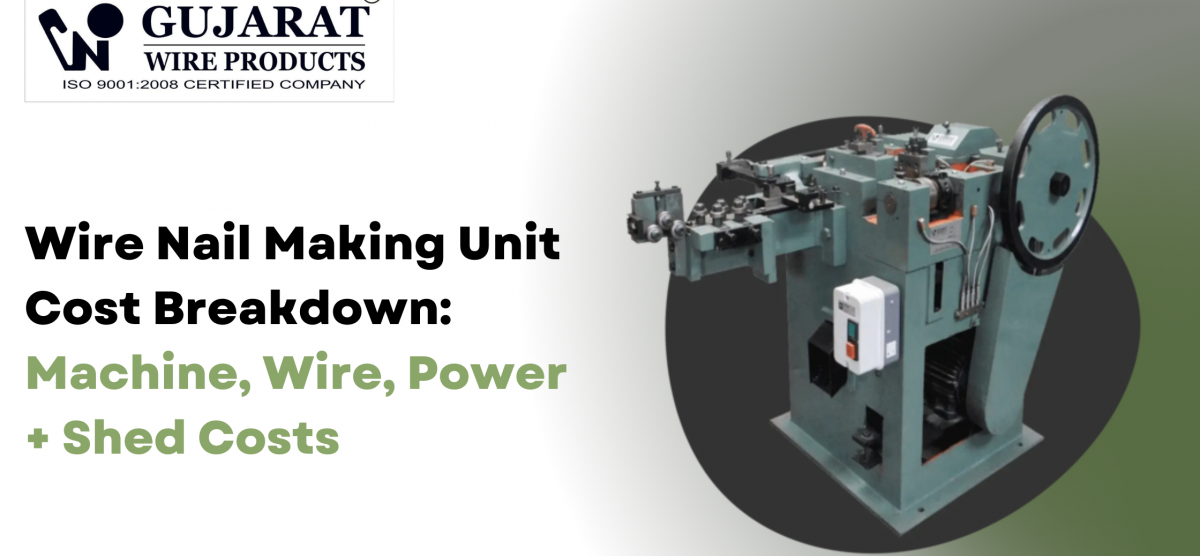
Wire Nail Making Unit Cost Breakdown: Machine, Wire, Power + Shed Costs
Ask what a nail unit costs and you will be handed a table with about eight lines on it. Machine, shed, licences, wire, working capital, done — call it ₹9 lakh. Then the money goes out and the number turns out to be wrong, not because anyone lied, but because the table leaves out the lines that only show up once you are actually building. This piece walks the full bill, item by item, including the ten or so costs nobody publishes. We build these machines, so we see what customers actually end up spending.
The Headline Number and Why It Slips
The standard published budget for a single-machine unit looks roughly like this:
| Line | Typical figure |
| Nail making machine | ₹2.8–3.5 lakh |
| Polishing barrel | ₹70,000 |
| Cutter grinder | ₹35,000 |
| Wire stands and hand tools | ₹7,000 |
| Land, building, electrification | ₹1.5 lakh |
| Licences | ₹50,000 |
| Opening wire stock | ₹32,000 |
| Working capital | ₹1 lakh |
It is not a bad starting point. It is just incomplete, and the gaps are not small ones.
Machinery: What the Quoted Price Does Not Include
GST on Capital Equipment
Machinery attracts 18% GST. On ₹3.9 lakh of equipment that is another ₹70,000 out of your bank account on day one. You will claim it back as input credit, but you fund it first, and that timing catches people.
Freight, Unloading and Installation
A nail machine is heavy. Budget for transport from the supplier, a crane or hydra to unload, and a day or two of commissioning. On a single machine this runs into tens of thousands. Buyers routinely leave it out and then treat it as an unpleasant surprise.
Foundation and Civil Work
The machine needs a level, load-bearing floor and bolting down. A polishing drum needs a spot where vibration is not a problem. If your shed has a thin floor, you are pouring a foundation before you produce a single nail.
Tooling You Will Buy Again
Gripping dies, header punches and cutters are consumables dressed up as parts. They come with the machine and then they wear out. Treat a first-year tooling reserve as part of the capital plan, not as a surprise expense in month seven.
Power: The Line Everyone Underestimates
“Electrification” as a single ₹1.5 lakh line covering land, building and power is where most published budgets quietly fail.
A three-phase LT industrial connection in Gujarat involves several separate charges:
- Application and registration fees to the distribution licensee.
- Security deposit, calculated per kW of sanctioned load — this is real money held against your account.
- Service line charges, which cover the cable run from the nearest pole or transformer to your meter.
- Internal wiring, panel, starters and earthing, done by your own contractor.
- A transformer, if your load or your location requires one.
The variable that swings this most is distance. A shed fifty metres from an existing line is cheap to connect. A shed at the back of an industrial estate with no nearby supply is not. Check the connection cost before you sign the shed lease, not after.
Then add a generator if your supply is unreliable. A nail machine earns only while it runs, so a unit that loses four hours a day to power cuts has a different business than the one in the spreadsheet.
Premises: Rent Is Not the Only Cost
- Deposit — typically several months of rent, held for the term.
- Flooring — a hard, level surface where the machines sit.
- Storage — wire coils in, finished sacks out; both are heavy and both need floor.
- Basic safety — extinguishers, first aid, a clear exit path.
Do not size the shed to the machine. Size it to the wire waiting to be run and the nails waiting to be collected.
Raw Material: Price It at Today’s Rate
This is the biggest correction to make against most published budgets.
Widely circulated figures put wire at ₹30,000–35,000 a tonne. In August 2026, steel wire rod trades at roughly ₹42,000–43,000 a tonne at mill level, with retail rod between ₹52 and ₹58 a kilo depending on grade and city. Drawn HB wire sits above rod.
Two consequences for the opening bill:
- Your first stock costs more than the table says. One tonne at current rates is a materially larger number than ₹32,000.
- Your working capital needs to be bigger. Wire is your largest recurring outflow, and steel prices move.
Packing and Dispatch
Small, unglamorous, and consistently missing from the budget.
- Sacks or cartons — per tonne, every tonne, forever.
- Weighing scale — you cannot sell by the kilo without one you trust.
- Strapping and stitching — machine or manual.
- Outbound freight — nails are heavy and low-value per kilo. Freight is a real share of your realisation, and it is the reason distant orders often look better on paper than in the bank.
Working Capital: The Line That Decides Survival
Most first units budget working capital as a round figure and pick ₹1 lakh because it sounds sensible. Work it out properly instead.
You need enough cash to cover, at the same time:
- Wire stock on the floor.
- Finished nails made but not yet sold.
- Nails sold but not yet paid for — dealers pay on 30 to 45 day terms as a matter of routine.
- One month of salaries, power and rent.
Add those four and the number is usually well past ₹1 lakh for anything beyond a single machine. Under-funding working capital is the single most common reason a technically sound nail unit stalls in its first year. The machine runs fine. The cash does not arrive fast enough to buy the next tonne of wire.
The Costs That Start the Month After
Setup is one budget. The monthly run rate is another, and new units routinely underestimate it because they cost only wire and salaries.
A single-machine unit carries, every month:
- Wire — by far the largest line, and paid for well before you are paid
- Salaries — two to three people
- Power — consumption plus fixed charges against sanctioned load
- Rent
- Tooling — dies, punches and cutters, amortised across the year
- Packing — sacks and stitching, per tonne shipped
- Outbound freight, where you deliver
- Accounting and compliance — returns filed monthly, whether you sold anything or not
- Loan repayment, if financed, starting whether the machine is running or not
That last one deserves attention. Repayment schedules begin on a date, not on an output level. A month lost to a delayed power connection is a month you pay for without producing.
A More Honest Single-Machine Budget
| Head | What it covers | Range |
| Machinery | Nail machine, drum, grinder, stands | ₹4–6 lakh |
| GST on machinery | 18%, recoverable later | ₹70,000–1 lakh |
| Freight and installation | Transport, unloading, commissioning | ₹25,000–60,000 |
| Civil and foundation | Floor, mounting, minor works | ₹30,000–1 lakh |
| Power connection | Deposit, service line, panel, wiring | ₹75,000–2.5 lakh |
| Premises deposit | Rent deposit and basic fit-out | ₹50,000–1.5 lakh |
| Licences and consents | Udyam, GST, GPCB, trade licence | ₹20,000–50,000 |
| Opening wire stock | At current rates | ₹1.5–3 lakh |
| Packing and weighing | Sacks, scale, strapping | ₹25,000–50,000 |
| Tooling reserve | First-year dies, punches, cutters | ₹40,000–1 lakh |
| Working capital | Stock, receivables, one month of costs | ₹2–4 lakh |
Ranges, not a single figure, because location and load change several of these lines by a factor of three.
FAQs
Why is the power connection cost so variable? Because service line charges depend on how far your shed sits from existing supply, and the security deposit scales with sanctioned load. Two identical units in different estates can pay very different amounts.
Can I claim GST back on the machinery? Yes, as input tax credit once you are registered and selling. The point is that you fund it upfront, so it belongs in your cash plan even though it does not belong in your final cost.
How much should I keep aside for tooling in year one? Enough to replace your wearing parts at least once. Dies and punches degrade nail quality before they fail outright, so running them long is a false economy.
Is a generator worth it from day one? If your area sees regular cuts, yes. Idle machine hours are pure loss, and the arithmetic usually favours the generator within a few months.
What is the most commonly missed cost? Working capital tied up in receivables. Dealers pay late; wire suppliers do not wait.
Conclusion
Build your budget bottom-up, from your own shed, your own power distance and today’s wire rate. The headline machine price is the easiest number to find and the least useful one on its own.
Send us your target nail sizes and monthly output, and we will give you a written machine specification and price — so at least one line of your budget is a real figure rather than an estimate.
About Gujarat Wire Products
We have been making wire nail machines, wire drawing machines, grinders and tooling in Rajkot since 1975, and installing them in units across India and overseas. Fifty-one years of commissioning first machines means we know which lines in a budget get missed, because we have watched it happen.
Get a real number before you plan around a guess. Tell us what you intend to produce and we will quote the machine that fits it.
📞 +91-98244 56375 · ✉️ info@gujaratwireproducts.com