Blog
How Much Space and Power a Nail Making Unit Actually Needs
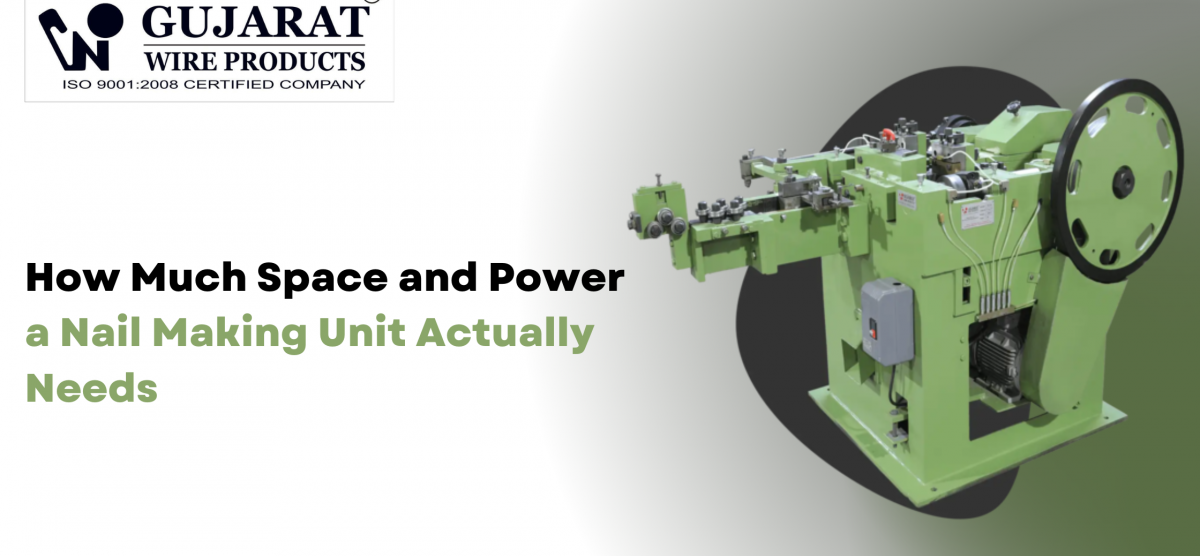
Two decisions get made early in a nail unit and quietly cap everything that follows: how big a shed you take and what electrical load you sanction. Both are cheap to get right at the start and expensive to fix later, because moving a commissioned machine and upgrading a sanctioned load are both slow, disruptive jobs. This piece gives you working figures for floor area, layout, connected load, voltage stability and backup power — and explains what happens when each one is undersized. We install these machines, so these are the constraints we see on site.
Floor Area: Working Figures
Start from the number of machines and add space for everything that moves around them.
| Setup | Machines | Practical floor area |
| Single machine | 1 nail machine, drum, grinder | 400–600 sq ft |
| Small plant | 2–3 nail machines, shared finishing | 1,000–1,500 sq ft |
| Larger plant | 4+ machines, integrated finishing | 2,000 sq ft and up |
| With wire drawing | Drawing line plus nail machines | 2,500 sq ft and up |
Those are working areas, not minimums. A single machine will physically fit in 300 square feet. It will not run well there, because you will be shifting wire coils to get to the polishing drum.
What the Space Is Actually For
The machine footprint is the smallest part of the requirement.
Wire Storage
HB wire arrives in coils, and coils are heavy and awkward. You want a defined area near the machine where a week’s wire can sit without being moved twice.
The Machine Bay
Around each nail machine, leave enough clearance for an operator to reach the header, the dies and the cutter from the side, and for someone to open the gearbox without dismantling the layout.
Finishing and Packing
The polishing drum, the weighing scale, the sack stack and the stitching point form a small production line of their own. Cramming them into a corner slows the whole unit.
Finished Stock
Nails sit before they ship. Dealers collect in batches. Plan for a stack of full sacks, not a clear floor.
Grinding
A cutter grinder needs a fixed, dust-tolerant spot with a bench, not a corner of the packing table. Operators who have to hunt for space to grind will grind less often, and nail quality will show it.
Lay It Out in the Order Material Moves
Most first sheds are laid out around where the power point happens to be. Lay it out around the material instead, because every metre a coil or a sack travels is paid for in labour hours.
The sequence is fixed: wire in → machine → polishing → weighing → packing → finished stock → out.
Arrange the floor so that flow runs in one direction, ideally toward the door goods leave by. Three practical consequences:
- Wire storage sits nearest the entrance, because coils are the heaviest thing you handle and you want the shortest possible carry.
- Finished stock sits nearest the exit, not in the corner behind the machine.
- The grinding bench sits off the main flow, where it is accessible but not in the traffic path.
Units that get this wrong do not notice for months. They just quietly pay two men to walk material back and forth across the shed all day.
Floor and Foundation
The floor matters more than the walls.
- Load-bearing and level. A nail machine is bolted down and runs at speed. An uneven or thin floor transmits vibration into everything around it.
- Hard surface. Metal dust and wire ends get walked around. A dusty or broken floor becomes a safety problem quickly.
- Vibration separation. Keep the polishing drum away from the grinding bench. Vibration and precision grinding do not belong on the same slab.
If you are taking an old shed with a cracked floor, cost the repair into your budget before you sign.
Electrical Load: How to Size It
Add up the connected load of everything, then leave headroom.
| Equipment | Typical motor |
| Automatic nail making machine (small sizes) | 2–3 HP |
| Automatic nail making machine (up to 4″) | 3–5 HP |
| Polishing barrel / drum | 1–2 HP |
| Cutter grinder | 1 HP |
| Wire drawing machine (if fitted) | Substantially higher, sized separately |
A single-machine unit with finishing equipment typically sanctions somewhere around 7 to 10 kW. Three machines with shared finishing runs well past that.
Sanction more than you currently need. Load enhancement is an application, a revised deposit and a wait. Adding a second machine and discovering your sanctioned load will not carry it is a self-inflicted delay.
Three Phase, Not Single Phase
An automatic nail making machine needs a stable three-phase supply. This is not a preference.
In Gujarat, the distribution licensee depends on your district — Rajkot and the wider Saurashtra region fall under PGVCL, with DGVCL, MGVCL and UGVCL covering the south, centre and north. The application process is similar across all four.
Three cost heads come with the connection:
- Security deposit, calculated against sanctioned load.
- Service line charges, for the run from the nearest supply point to your meter.
- Internal work — panel, starters, earthing, wiring — done by your own contractor.
The one that varies wildly is service line charges, because they depend on distance. Ask the licensee what the connection will cost for a specific address before you commit to that address. Two sheds with the same rent can differ by more than a lakh on this line alone.
Voltage Stability Beats Raw Capacity
This is the part experienced operators care about and new buyers do not.
A nail machine running on fluctuating voltage produces two problems. Motors run hot and fail early. And the header does not strike consistently, which shows up as variable head quality long before anything actually breaks.
Practical measures:
- Fit a proper starter and overload protection on every motor.
- Earth the installation properly, and check it, rather than assuming the contractor did.
- If your area is known for fluctuation, a stabiliser on sensitive equipment costs less than a rewound motor.
Backup Power: Do the Arithmetic
A nail machine earns money only while it is running. That single fact drives the generator decision.
Work out how many hours a month you actually lose to cuts. Multiply by your output per hour and your margin per kilo. Compare that with the cost of a generator sized to your connected load plus starting current.
In areas with regular cuts, the generator usually pays back within months. In areas with reliable supply, it is dead capital. Measure your own supply before deciding — do not copy someone else’s answer.
Running Cost of Power
Electricity is a modest but constant line. Commercial tariffs in Gujarat run around ₹7.5 per unit, with monthly fixed charges stepping up by sanctioned load; industrial tariffs and demand charges differ by category and licensee.
The number that matters is not the tariff. It is units consumed per tonne of nails produced. Track it. A machine running well, with sharp tooling and correct wire, consumes noticeably less power per tonne than one that is fighting itself.
Noise, Dust and Consents
Nail machines are loud and they throw metal dust. Two practical implications:
- Consent from the state pollution control board is required in most states, including Gujarat. Plan for it during setup rather than after a complaint.
- Neighbours matter. A unit in a residential-adjacent plot will face complaints that the same unit in an industrial estate never sees.
Hearing protection for operators is basic, cheap and routinely skipped.
FAQs
Can I start a nail unit in a 300 sq ft shed? The machine will fit. Wire storage, finishing and finished stock will not. You will spend labour hours moving material that a slightly larger shed would let you leave in place.
What load should I sanction for one machine? Roughly 7–10 kW covers a single automatic machine with a polishing drum and grinder. Sanction with headroom if a second machine is likely within two years.
Does the shed need a special foundation? It needs a level, load-bearing floor that the machine can be bolted to. Most sound industrial sheds already have this; old or thin flooring will need work.
How much does a three-phase connection cost? It depends almost entirely on distance from existing supply and your sanctioned load. Get a quotation from your licensee for the specific address before finalising it.
Is a generator necessary? Only if your supply is unreliable. Count your actual lost hours, price them against your margin, and decide from that.
Conclusion
Take the shed for the unit you will have in two years, not the machine you are buying this month. Sanction load with headroom. Check the power connection cost against a specific address before you sign anything.
Tell us how many machines you plan to run and what sizes you intend to produce, and we will send you exact footprint, load and clearance figures for the equipment — so you can size the shed and the connection properly the first time.
About Gujarat Wire Products
We have built and installed wire nail making machines, wire drawing machines, grinders and tooling from Rajkot since 1975, across India and overseas. Fifty-one years of commissioning machines on real shop floors means we can tell you what a layout needs before you take the shed, not after.
Plan the space and the supply before the machine arrives. Send us your production target and we will send you the specifications to build around.