Blog
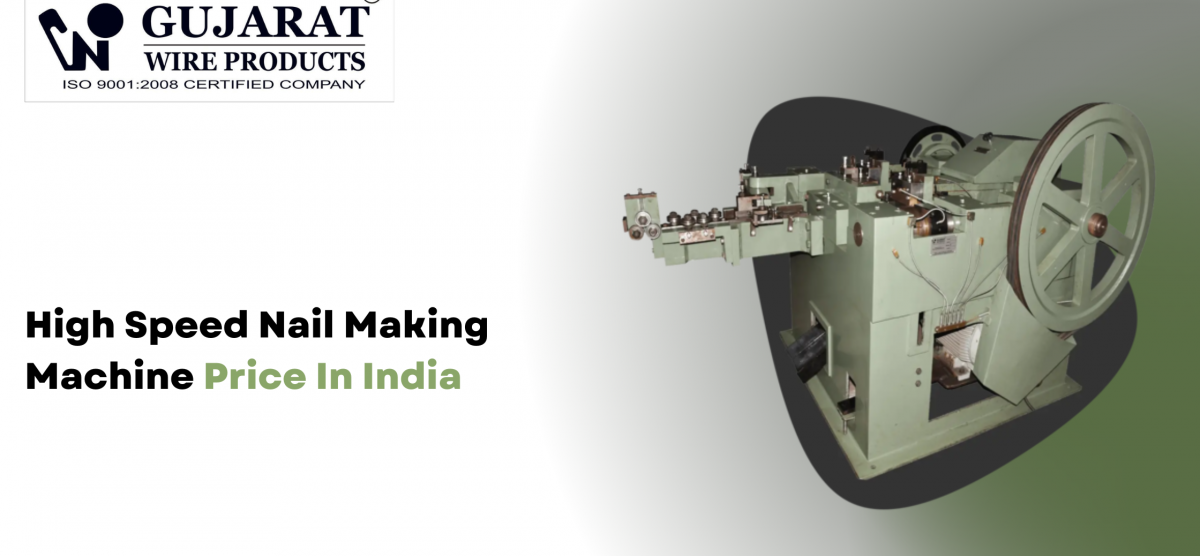
High Speed Nail Making Machine: Price and Comparison
Ask five sellers for a high speed nail making machine price and you will get five numbers that are hard to compare. One quote covers the bare machine, another bundles tools, a third quotes a different size class altogether. Buyers end up comparing price tags instead of what each rupee produces.
This guide puts the numbers side by side. We have built nail machines in Rajkot since 1975, including PLC-controlled high speed models, so we see these quotes from both sides of the table. You will learn what “high speed” actually means, current price bands in India, what pushes a price up, and how to compare machines on cost per kilogram.
What Makes a Nail Machine “High Speed”
There is no official cut-off. In practice, a high speed machine is one that runs faster than the conventional machine built for the same wire range.
That speed comes from three changes:
- A stiffer, balanced frame that holds tolerances at higher crank speeds
- Forced lubrication in place of manual oiling, so bearings and slides stay cool
- Better tool materials, often tungsten carbide, so dies and cutters last at higher stroke rates
PLC-controlled machines go one step further. They add sensors, automatic nail counting, drive control and fault stops.
High Speed Nail Making Machine Price in India
Listings on Indian B2B marketplaces in October 2026 give a fair picture of the market:
- Conventional medium machines (1–3 inch): roughly ₹1.5 lakh to ₹6 lakh, depending on size and build
- Heavy machines (up to 6 inch): often listed between ₹9.5 lakh and ₹10.5 lakh
- High speed and PLC models: above the conventional machine of the same size class, by a margin that depends on controls and tooling
- Imported rotary machines: up to about USD 200,000 each
Treat any listed price as a starting point. Check whether it includes GST, tooling, freight and installation before you compare two quotes.
What Drives the Price
Two machines with the same nails-per-minute figure can differ by lakhs. These are the usual reasons:
- Size class. Heavier frames need more casting weight and bigger motors. Our GN6 weighs about 2,500 kg net against 460 kg for the GN1.
- Speed and controls. PLC control, sensors and drives add cost but cut labour and scrap.
- Tool material. Carbide gripping dies and cutters cost more upfront and last much longer.
- Casting and machining quality. Close-grain castings and precision-machined slides hold alignment for years.
- What is in the box. A first set of tools, spare cutters and installation support change the real price.
Conventional vs High Speed vs Rotary: Comparison
| Factor | Conventional | High speed / PLC | Imported rotary |
| Typical speed (medium nails) | 250–400 nails/min | 300–760 nails/min | Far higher |
| Relative cost | Lowest | Moderate premium | Highest, often 10× crank machines |
| Operator ratio | 1 operator for a few machines | Up to 1 operator for 8 machines (GHS90) | Specialist staff |
| Spares and service | Local, quick | Local, quick | Often imported |
| Best fit | Small units, varied short runs | Growing units with steady orders | Very high-volume single sizes |
Model-by-Model Comparison
The fairest comparison is between conventional and high speed machines that take the same wire. Here is our own range:
| Size class | Conventional | High speed | Speed gain |
| 2.0–2.9 mm wire, 12–65 mm nails | GN2: 400/min | GHN2: 450/min | +12.5% |
| 2.6–3.6/4.0 mm wire, 25–85 mm nails | GN3: 350/min | GHN3: 400/min | +14% |
| 2.64–4.8 mm wire, 25–125 mm nails | GN4: 250/min | GHN4: 300/min | +20% |
| 2.0–3.8 mm wire, 40–90 mm nails | GN3: 350/min | GHS90: 760/min | About 2.2× |
Power stays the same between each GN and GHN pair. The GHN2 and GN2 both use 2 HP, and the GHN4 and GN4 both use 5 HP. The extra output comes without extra motor load.
What the GHS90 Adds
The GHS90 is our PLC-controlled model. Its main features:
- Up to 760 nails per minute
- 10 HP rated, with about 6 HP actual draw
- Seven sensors for safety and nail counting
- Automatic lubrication
- Tungsten carbide tooling
- One skilled operator can run up to eight machines
Measured output at 85% efficiency on 3.25 mm × 75 mm nails is about 1,350 kg per 8-hour shift.
Cost per Kg: The Number That Matters
Machine price is paid once. Cost per kilogram is paid every day. A cheaper machine can cost more per kilogram if it needs more labour, more tool changes or more stoppages.
A Simple Way to Compare
For each machine you are considering, work out:
- Monthly output in kg for your main nail size
- Monthly labour cost for the operators it needs
- Monthly tooling cost for dies, cutters and punches
- Monthly power cost
- Monthly capital cost, spreading the machine price over the years you expect to use it
Add items 2 to 5 and divide by item 1. That is your cost per kilogram.
Where the Surprise Usually Is
Labour is the line most buyers underestimate. On conventional machines, operators are usually spread across a handful of machines. On a PLC line with a one-to-eight ratio, labour cost per kilogram can drop sharply, even if the machine price is higher.
Tooling is the second surprise. Carbide tools cost more per set but run far longer between changes. Fewer changes also means more running minutes per shift.
How to Decide Between Conventional and High Speed
- Choose conventional if you make many sizes in short runs, your orders are irregular, or labour is cheap and plentiful in your area.
- Choose high speed if two or three sizes make up most of your sales, you run more than one shift, or skilled operators are hard to find.
- Mix both if you have one high-volume size and several small-volume sizes. Put the volume size on a high speed machine and the rest on conventional ones.
FAQs
What is the price of a high speed nail making machine in India?
It depends on size class and controls. Conventional medium machines are often listed between ₹1.5 lakh and ₹6 lakh, and high speed models of the same size cost more. Ask for a quote that states tooling, GST and installation clearly.
Is a high speed nail machine worth the extra cost?
It is when your order book is steady and concentrated in a few sizes. The gain comes from more kilograms per operator and fewer tool changes. For short, mixed runs, a conventional machine often makes more sense.
Does a high speed machine use more electricity?
Not much, in our range. Each GHN model uses the same motor rating as its GN equivalent. The GHS90 is rated at 10 HP but draws about 6 HP in normal running.
How long do tools last on a high speed machine?
Tool life depends on wire quality, nail size and lubrication. Carbide tools, used on our GHS90, last much longer than conventional tool steel. Clean, correctly drawn wire extends tool life on any machine.
Can a high speed machine make all nail types?
It makes most standard wire nails within its range. Special heads, such as umbrella or washer heads, may need dedicated tooling or a dedicated machine. Share your nail drawings and we will confirm.
Conclusion
Compare high speed nail machines on cost per kilogram, not on price tag or nails per minute alone. Match conventional or high speed machines to your order pattern, and price tooling and labour into every quote.
Send us your main nail sizes and shift pattern, and we will prepare a side-by-side cost-per-kg comparison for your plant.
About Gujarat Wire Products
Gujarat Wire Products has manufactured conventional and high speed wire nail making machines in Rajkot since 1975. Our range runs from the GN1 for small pins to the PLC-controlled GHS90 at up to 760 nails per minute. We also make wire drawing machines, grinders, polishing drums and the tools every nail line needs. We supply across India and export to Africa, the UK, Europe and Asia.
Our promise: a clear quote, matched to your nails,