Blog
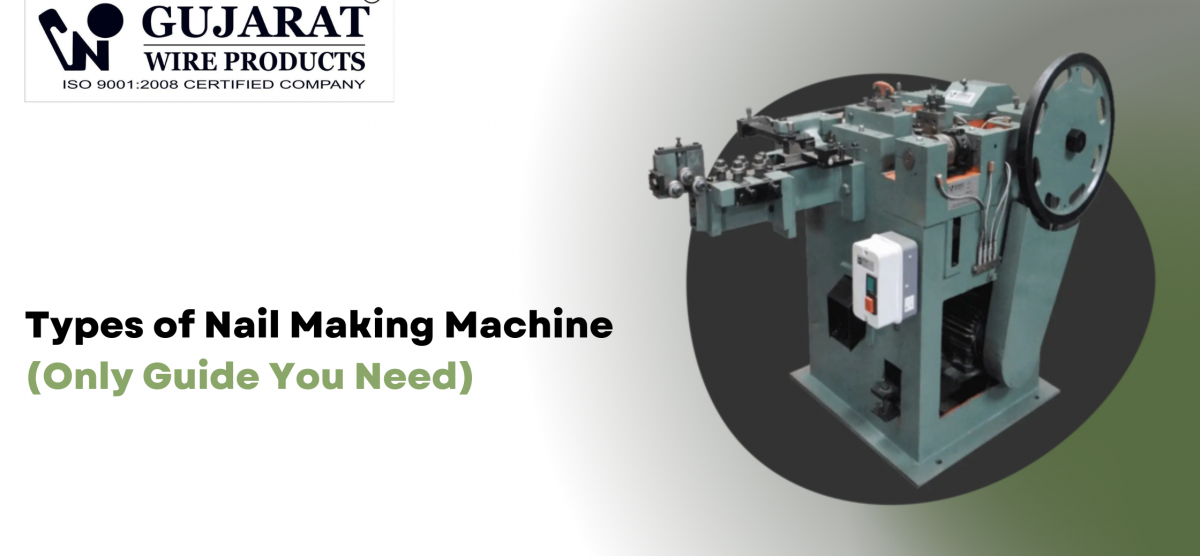
Types of Nail Making Machine (Know The Basics)
Most buyers shortlist a nail making machine on one number: nails per minute. That number says very little about how many kilograms you will sell at the end of a shift. A wrong pick usually shows up months later, as a machine sitting idle on one size while orders for another size pile up.
This guide sorts that out. We have built wire nail machines in Rajkot since 1975, and these are the questions we walk every buyer through. You will learn the main machine types, how to read capacity in kilograms instead of pieces, and a step-by-step method to match a machine to your market.
What Is a Nail Making Machine
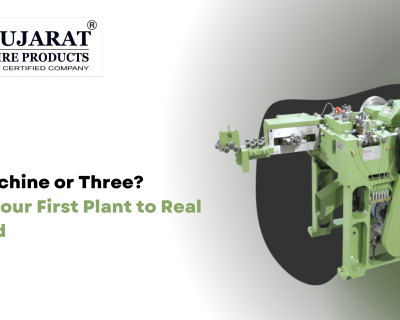
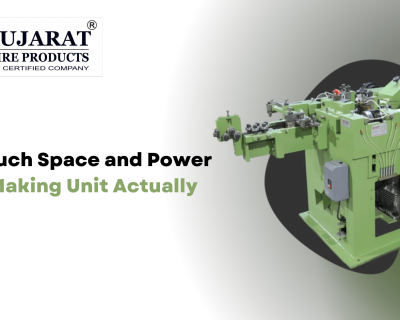
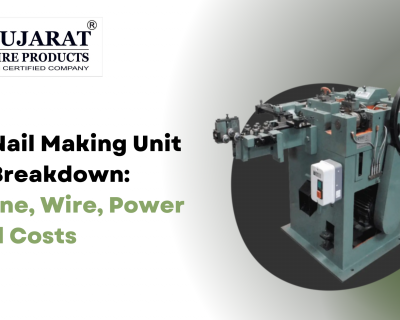
A nail making machine turns a coil of drawn steel wire into finished nails in one continuous cycle. The wire is straightened, gripped, headed, cut to length and pointed, all in a single revolution of the main crank. One revolution equals one nail.
The process is cold forming. No heat is applied, so the nail keeps the strength that wire drawing has already given it. Polishing comes later, in a separate barrel drum.
Types of Nail Making Machines
Machines are grouped in four practical ways. Buyers often mix these up, so it helps to keep them apart.
By Automation Level
- Semi-automatic machines need an operator to handle more of the setup and feeding. They suit small workshops making short runs.
- Fully automatic machines feed, head, cut and eject without manual steps once the coil is loaded. This is the standard for commercial production.
- PLC-controlled high speed machines add sensors, nail counting, automatic lubrication and drive control. Our GHS90 falls in this group.
By Nail Size Range
Every machine is built around a band of wire diameters and nail lengths. Running a heavy machine on small nails wastes power and floor space. Running a light machine on thick wire breaks tools.
- Small nails (6–38 mm): panel pins, shoe tacks, upholstery nails
- Medium nails (12–90 mm): the bulk of construction and carpentry demand
- Heavy nails (up to 150 mm): structural timber, crating, heavy formwork
By Speed Class
Conventional machines cover every size class. High speed versions of the same frame size run roughly 12–20% faster in the same wire range, and PLC models go further. Our GHN2 runs at 450 nails/min against 400 for the conventional GN2, on identical wire.
By Nail Type
The same core machine, with different tooling, can produce:
- Common wire nails (flat head)
- Roofing and umbrella-head nails
- Concrete nails
- Panel pins and lost-head nails
- Shoe tacks and clout nails
- Spiral nails
Coil nails for pneumatic guns need an extra collating line after the nail machine.
Crank-Type vs Rotary Machines
Nearly all nail factories worldwide run crank-type machines. Imported rotary machines are far faster but can cost up to USD 200,000 each, which is more than ten crank machines. For Indian and African markets selling loose nails by the kilogram, the crank machine remains the commercial default.
Understanding Nail Machine Capacity
This is where most buying decisions go wrong. Nails are sold by weight, not by count, so output has to be measured in kilograms per shift.
The Formula
Kg per shift = nails per minute × minutes run × efficiency × weight of one nail
Use 80–85% efficiency for a well-run line. The rest is lost to coil changes, tool changes and minor stoppages.
Why the Fastest Machine Is Not the Biggest Producer
Here is a comparison from our own range, over an 8-hour shift at 85% efficiency:
| Machine | Speed | Typical nail | Approx. weight per nail | Output per 8 hours |
| GN1 | 500/min | 1.2 mm × 25 mm | 0.23 g | ~47 kg |
| GN3 | 350/min | 3.25 mm × 75 mm | 5.1 g | ~730 kg |
| GN6 | 150/min | 5 mm × 125 mm | 20 g | ~1,200 kg |
The slowest machine in the table produces about 25 times the tonnage of the fastest. Speed only matters once you have picked the right size class.
Measured Data From a High Speed Line
Our GHS90 test data shows the same pattern. At 650 nails/min on 3.25 mm × 75 mm nails it produces about 1,350 kg in 8 hours. Push it to 760 nails/min on 2 mm × 45 mm nails and output drops to about 425 kg.
Model Range at a Glance
| Model | Wire diameter | Nail length | Max nails/min | Power |
| GN1 | 0.9–1.83 mm | 6–38 mm | 500 | 1.5 HP |
| GN2 | 2.0–2.9 mm | 12–65 mm | 400 | 2 HP |
| GN3 | 2.6–4.0 mm | 25–85 mm | 350 | 3 HP |
| GN4 | 2.64–4.8 mm | 25–125 mm | 250 | 5 HP |
| GN6 | 4.0–6.0 mm | 38–150 mm | 150 | 10 HP |
| GHN2 | 2.0–2.9 mm | 12–65 mm | 450 | 2 HP |
| GHN3 | 2.6–3.6 mm | 25–75 mm | 400 | 3 HP |
| GHN4 | 2.64–4.8 mm | 25–125 mm | 300 | 5 HP |
| GHS90 | 2.0–3.8 mm | 40–90 mm | 760 | 10 HP rated, ~6 HP actual |
How to Choose a Nail Making Machine
Follow these steps in order. Each one narrows the list.
- List the nails your buyers actually order. Write down each size by gauge and length, and the share of monthly volume it takes up. In most Indian markets, 1.5 to 3 inch nails carry the bulk of tonnage.
- Convert your target tonnage into machine hours. Use the formula above for each main size. This tells you whether you need one machine or three.
- Map each size to a machine range. Pick machines whose middle range covers your best-selling sizes. Avoid buying for the edge of a range, where tool wear is highest.
- Check your wire supply. The drawn wire diameter must sit inside the machine’s range. If you buy wire rod instead of drawn wire, you also need a wire drawing machine.
- Check power and floor space. A GN1 needs about 1,100 × 755 mm of floor. A GN6 needs about 1,350 × 1,270 mm and a 10 HP supply.
- Price the tooling, not just the machine. Gripping dies, cutters and header punches are consumables. Ask what each costs and how long it lasts on your wire.
- Count labour. On a PLC machine like the GHS90, one skilled operator can run up to eight machines. That changes the economics of a large plant.
- Ask for a trial run on your own wire. A demonstration on the seller’s wire tells you little about your results.
Common Buying Mistakes
- Buying one heavy machine to “cover everything” and then running it on small nails at a fraction of its tonnage
- Comparing quotes on nails per minute without asking which nail size that speed applies to
- Ignoring tool life, which decides running cost more than electricity does
- Skipping the wire drawing question until the machine has already arrived
FAQs
How many nails can a nail making machine produce per minute?
It depends on the model and nail size. Conventional machines run from about 150 nails/min on large nails to 500 nails/min on small ones. PLC-controlled high speed machines like our GHS90 reach up to 760 nails/min.
Which nail making machine is best for a new business?
Most new units start with a medium-range machine such as the GN3 or GHN3, which covers 1 to 3 inch nails. That band carries most construction demand. You can add a small or heavy machine once your order mix is clear.
Can one machine make different nail sizes?
Yes, within its wire diameter and length range. Changing size means swapping the gripping die and cutters and resetting the feed length. Grouping orders by size keeps these changeovers to a minimum.
Do I need a wire drawing machine as well?
Only if you buy wire rod. If you buy ready drawn wire in the correct diameter, the nail machine can run directly from the coil. Many units add drawing later to cut raw material cost.
What power supply does a nail making machine need?
Our machines run on standard three-phase industrial supply. Motor sizes range from 1.5 HP for the GN1 to 10 HP for the GN6 and GHS90.
Conclusion
Choose the size class first, then the speed, then the automation level. Measure every option in kilograms per shift for the nails you actually sell. Ask for a trial on your own wire before you sign.
If you are comparing models now, send us your nail size list and monthly target. We will reply with a machine plan and output estimate.
About Gujarat Wire Products
Gujarat Wire Products has manufactured wire nail making machines, high speed nail machines and wire drawing machines in Rajkot since 1975. We are ISO 9001 certified and supply machines across India and to buyers in Africa, the UK, Europe and Asia. We also make the tools that keep them running: gripping dies, cutters, header punches, grinders and polishing drums.
Our promise is simple. We match the machine to your nails and your tonnage, not to our price list.