Blog
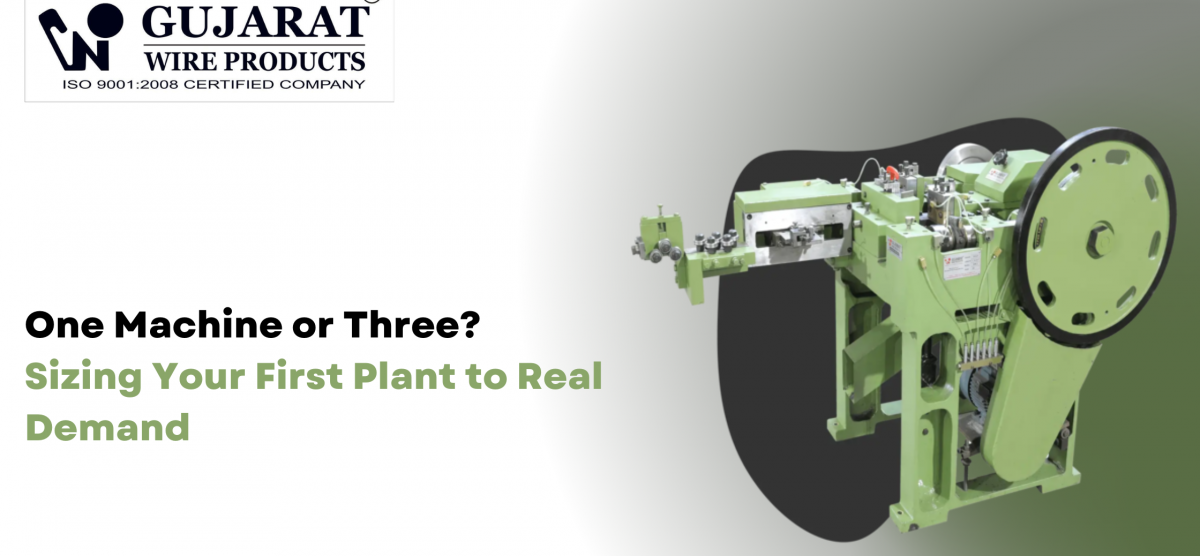
One Machine or Three? Sizing Your First Plant to Real Demand
The most expensive mistake in this business is not buying the wrong machine. It is buying too many of the right ones. Capacity is easy to add and hard to unwind: an idle machine still carries interest, still occupies the floor, and still needs a power connection to run it. This piece shows you how to work out what you can actually sell before you decide what to buy, how to convert a machine’s rating into real monthly tonnage, and when the second and third machines genuinely make sense. We supply these machines, and we would rather sell you one that runs than three that do not.
Start From Offtake, Not From Capacity
Before you look at a single specification, answer three questions with real numbers.
Who Will Buy It?
Name the dealers or distributors. Not a category — actual businesses within economical freight distance. Nails are heavy and low-value per kilo, so your market is geographic before it is anything else.
How Much Do They Move?
Ask them. Most hardware distributors will tell you roughly what they shift monthly and in which sizes, because they want another supplier option. This one conversation is worth more than any market report.
In What Sizes?
Size mix determines everything downstream — which machine you buy, which wire gauges you stock, and what margin you earn. A dealer moving mostly 3″ and 4″ nails needs a different machine than one selling 1″ and 1½”.
If you cannot answer these three, you are not ready to size a plant. You are ready to have some conversations.
Converting a Machine Rating Into Tonnage
Machine specifications are quoted two ways, and mixing them up leads to bad decisions.
Nails per minute is the honest mechanical rating. Standard automatic machines run roughly 250–300 nails a minute; high-speed machines go well beyond.
Kilos per day is a derived figure — and it depends entirely on the nail size assumed.
That distinction matters more than most buyers realise. A machine rated at 250 nails a minute making ½”–4″ nails will show a far higher kilo output than a machine rated at 300 nails a minute making ½”–2″ nails, because bigger nails weigh more. Two machines both advertised at “600 kg per day” can be completely different propositions.
Always ask: at what nail size is that kilo rating calculated?
Then Apply a Realistic Utilisation
Here is the number nobody builds into their plan.
Indian manufacturing as a whole has run in the mid-to-high seventies for capacity utilisation in recent RBI surveys — and that is established industry with settled order books. A first-year nail unit will not beat it.
You lose hours to:
- Power cuts and voltage problems
- Tooling changes and grinding
- Breakdowns and maintenance
- Waiting for wire
- Changing over between nail sizes
So take the rated output, apply something like 70–80%, and plan on that. A machine rated at 850 kg a day realistically delivers somewhere around 600–680 kg in a working day, and about 15 tonnes across 26 days. Plans built on 100% of the rating fail in month three, and they fail in the worst way — with a loan repayment sized to output you never produced.
One Machine
Right when:
- You have no committed offtake yet
- You are learning the process, the wire market and the dealers at the same time
- You want to prove the unit works before scaling the risk
A single automatic machine with a polishing drum and grinder produces a genuine, sellable tonnage. It is enough to establish dealer relationships and find out what your real recovery rate and uptime look like.
The learning is the point. Everything you find out in year one — your actual wastage, your collection period, which sizes move — makes the second decision far better than the first one could have been.
Two or Three Machines
Right when:
- You already have dealer commitments you cannot fill
- Your existing machine is running at genuine high utilisation, measured not assumed
- You want to run different size ranges simultaneously without changeovers
That last point is underrated. Changing a machine between size ranges costs setup time. Two machines dedicated to different ranges often produce more than two machines both switching around.
Finishing equipment shares well — one polishing drum and one grinder typically serve two or three nail machines — so the incremental cost of machine two is lower than machine one. The floor space and the power sanction are not shared, and both need planning.
Before You Buy a Machine, Consider a Second Shift
This is the option most buyers never price, and it is often the better one.
If your single machine is running full during the day and you have orders you cannot fill, you have two ways to double output. Buy another machine, or run the one you have for a second shift.
The second shift needs:
- Another operator and a finishing hand
- No additional capital, floor space, or power sanction
- No additional interest, depreciation or deposit
The machine purchase needs all of those. Labour is a variable cost you can stop; a financed machine is a fixed one you cannot.
Run the shift first. If demand holds for six months and both shifts are full, you have proved the market and the machine purchase becomes an easy decision rather than a bet. If demand was seasonal, you scale the shift back and lose nothing.
The exception is when the constraint is size range rather than hours — a second shift cannot make a nail your machine is not rated for.
Range Beats Count
If your budget stretches to either a second standard machine or one machine covering a wider size range, think carefully.
Larger nails generally carry better margin, and a machine rated only to two inches simply cannot make them. Adding a second narrow machine doubles your output in the sizes with the thinnest margins. Adding size range opens the sizes with the best ones.
This is the most common sizing error we see: buyers optimise for volume when they should be optimising for mix.
The Staged Path That Works
- Year one: one machine, learn the numbers, build two or three dealer relationships.
- Year two: add a second machine when your first is genuinely full and you have orders you are turning away.
- Year three: consider wire drawing once your monthly tonnage is predictable, because that is where the margin improvement lives.
Compare that with the alternative — three machines on day one, financed, waiting for a market you have not built yet. Same total investment, entirely different risk.
The Cost of Getting It Wrong Upwards
An idle machine is not neutral. It carries:
- Interest, if financed, from the month it lands
- Depreciation, whether it runs or not
- Floor space, which you are paying rent on
- Sanctioned load, which you paid a deposit against and may pay fixed charges on
None of that is recovered by the machine eventually being useful. Buying capacity a year early costs a year of carrying it.
FAQs
How many nails per minute is a good rating? Standard automatic machines run 250–300 a minute. High-speed machines exceed that. The right answer depends on your size mix and your offtake, not on the biggest number available.
What utilisation should I plan for? 70–80% of rated output for a first-year unit. Established manufacturing across India runs in the mid-to-high seventies, and a new unit has more to learn.
Can one polishing drum serve multiple nail machines? Usually yes — finishing equipment generally keeps up with two or three nail machines, which makes the second machine cheaper to add than the first.
Should I buy a wider size range or a second machine? If your dealers move larger sizes, range almost always wins. Larger nails carry better margin, and no amount of extra volume in small sizes makes up for being locked out of them.
When does wire drawing make sense? Once your monthly wire consumption is steady and predictable. It is a margin decision that needs volume behind it, not a starting configuration.
Conclusion
Talk to your dealers before you talk to a machine supplier. Convert ratings into realistic tonnage using 70–80% utilisation. Buy the size range your market actually moves, and add machines only when the first one is genuinely full.
Tell us the sizes your dealers move and the monthly tonnage you need, and we will tell you how many machines that requires — including if the answer is one.
About Gujarat Wire Products
We have manufactured wire nail making machines, wire drawing machines, grinders and tooling in Rajkot since 1975, supplying units across India and overseas. Fifty-one years of installations means we have seen what happens when a unit is sized to a spreadsheet instead of to a market.
Get the sizing right before you commit capital. Send us your target output and size mix, and we will specify honestly.