Blog
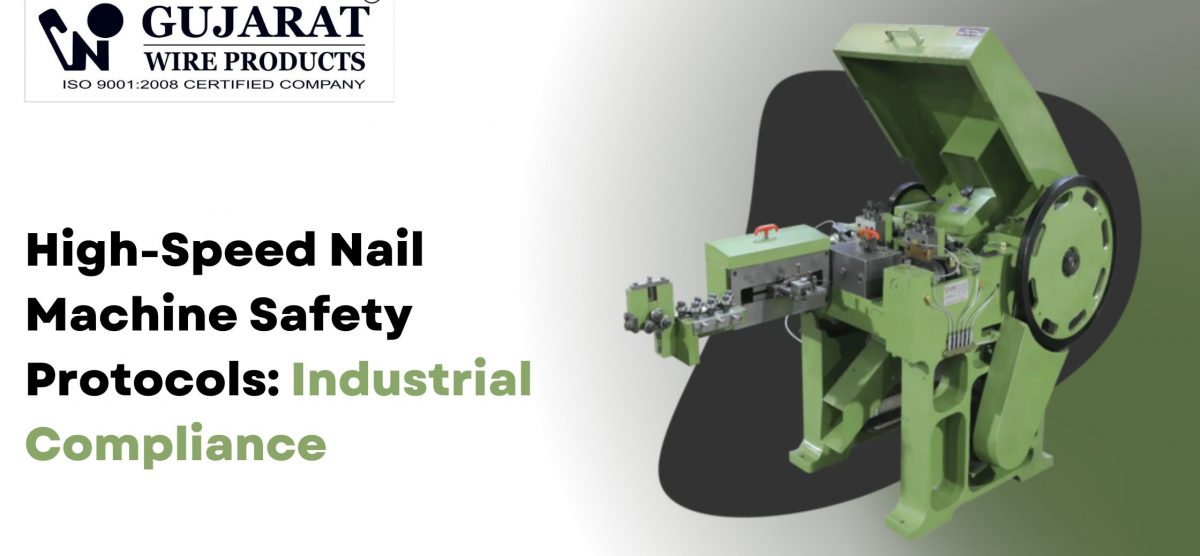
High-Speed Nail Machine Safety Protocols: Industrial Compliance
High-speed nail making machines run at 300–800 cycles per minute. At that speed, a single skipped safety check doesn’t just risk a defective batch—it risks a serious injury. Yet the most common cause of nail machine accidents isn’t operator recklessness; it’s institutional drift: guards removed “temporarily” that never go back on, lubrication schedules skipped during deadline pressure, and operators trained by watching someone else who was never formally trained. Studies on industrial machinery injuries consistently show that the majority of incidents involve machines with functioning safety systems that were bypassed or ignored, not machines that lacked them. The solution is a structured safety framework embedded into daily operations—not posted on a wall. This guide covers regulatory compliance standards, pre-start checks, PPE requirements, operational protocols, emergency procedures, maintenance-linked safety, and operator training practices. Follow this framework and your nail production floor runs at full speed without the accident costs that derail both schedules and regulatory standing.
Safety regulations and compliance standards
High-speed nail machines fall under general industrial machinery safety regulations in most jurisdictions. The applicable frameworks cover machine guarding, electrical safety, and operator exposure limits.
Key compliance areas to address:
- Machine guarding: All moving parts—flywheel, cams, transmission belts, die block—must be guarded per OSHA 1910.212 or equivalent national standard
- Electrical safety: Proper earthing with grounding wire cross-section matching or exceeding conductor size; all control panels with overload protection and emergency circuits
- Noise exposure limits: Most nail machines exceed 85 dB at the operator position; mandatory hearing protection above this threshold under IS/OSHA noise standards
- Lockout/tagout (LOTO): Required procedure during any servicing, die change, or jam clearing to prevent accidental energization
Non-compliance isn’t primarily a fine risk—it’s a liability risk. An unguarded machine that injures an operator exposes the business to compensation claims, production shutdown, and mandatory audit.
Pre-start safety checks
Electrical and power checks
- Verify main circuit switch condition and transmission cable integrity before energizing
- Confirm earthing connection is secure and grounding wire cross-section meets specification
- Check control panel for tripped breakers, loose terminals, or heat-damaged insulation
- Test emergency stop button function before every shift—not weekly, every shift
Mechanical pre-run inspection
- Hand-turn the flywheel through one complete cycle with machine off—this catches obstructions, loose fasteners, and die block misalignment before they become in-motion hazards
- Confirm oil tank is filled; running without lubrication triggers rapid heat buildup in bearing surfaces within minutes
- Verify all safety guards and covers are properly seated and interlocks are functional
- Inspect wire feed path for kinks, scale buildup, or diameter variation before threading
Wire and material checks
- Measure incoming wire diameter at three points per coil; reject any coil showing variation above ±0.05mm
- Never feed rusty, scaled, or surface-contaminated wire—hard inclusions cause mechanical shock loads that stress the die block and can fracture it
PPE requirements
The right PPE for high-speed nail machine operation:
- Eye and face protection: Full face shield, not just safety glasses—chips eject sideways and upward from the cutting zone
- Hearing protection: Earplugs or earmuffs rated to reduce exposure below 85 dB; foam plugs worn incorrectly provide near-zero protection
- Cut-resistant gloves: When handling wire coils and finished nails during loading and collection—not while the machine is running
- Clothing: No loose sleeves, drawstrings, jewellery, wristwatches, or rings; rotating components catch fabric and metal in milliseconds
The contrarian finding here: studies on hand injuries from industrial forming machines show that gloves worn during machine operation—rather than during material handling—are a contributing factor in entanglement injuries, not a preventive one. The correct protocol is gloves off while the machine cycles, gloves on for handling.
Operational safety protocols
Safe operating procedures
These are the actions that cause the majority of nail machine injuries when skipped:
- Never adjust die gap, cutter position, or feed roller settings while the machine is in motion—stop the machine completely before touching any forming component
- Never touch the flywheel or transmission belt with hands or tools while the machine is running
- Never stop the flywheel manually; let it decelerate under its own inertia after power-off
- Keep fingers clear of the gap between the nail feed tube and the forming die—the entry angle is too tight to recover from contact
Machine guarding rules
- Replace all protective covers immediately after inspection or maintenance; there is no safe “temporary” state for an unguarded machine
- Never tape over, disable, or mechanically bypass safety sensors or interlock switches
- Report any guard that vibrates loose during operation as a maintenance fault—don’t simply reinstall it and continue
Noise and dust control
- Route metal dust extraction to an enclosed collection system, not open discharge into the workspace
- Rotate operators on high-noise positions to limit individual daily exposure where hearing protection alone is insufficient
Emergency procedures
Every operator needs to know these before their first shift—not during an incident:
- Abnormal noise or vibration: Stop machine immediately, do not investigate while running; power off and lock out before inspecting
- Wire jam in die block: Power off, apply LOTO, clear the jam with appropriate tools—never use fingers to pull jammed wire from a powered machine
- Overheating: Stop production, allow cooling, check lubrication and cooling path before restarting
- Electrical fault or tripping: Do not reset breakers without identifying the cause first—repeated tripping indicates mechanical binding, not an electrical problem
Document every emergency stop and its cause. Patterns in the log reveal maintenance issues before they become failure events.
Maintenance-linked safety
Lubrication as a safety function
Lubrication failure is the most common mechanical cause of in-service component fracture on nail machines.
- Lubricate cam followers, bearings, and linkages at minimum three times per shift on continuous-run machines
- Monitor friction surface temperatures during operation; a sudden rise signals lubrication breakdown or misalignment
- Change gearbox oil on schedule—degraded oil loses viscosity at operating temperature and provides inadequate film protection
Tooling condition and safety
Dull or damaged tooling is a safety hazard, not just a quality problem. A cutting knife that’s running past its service interval exerts higher load on the cutter mechanism, increasing fracture risk. A cracked heading die can release fragments at forming speed.
- Inspect cutting knives every 8 hours and replace before visible deterioration becomes structural compromise
- Check heading dies for surface cracks, chipping, or deformation at every tool change
- Use only manufacturer-specified replacement parts—mismatched components alter the load distribution in the forming mechanism
Operator training and safety culture
Untrained operators don’t just create safety risk for themselves—they create risk for every person in the production area.
Train every operator on:
- Machine-specific pre-start checklist completion
- LOTO procedure for their assigned machine
- Emergency stop location and correct response procedure
- Reporting protocol for near-misses and abnormal machine behavior
The organizational pattern that drives injury rates down most reliably: near-miss reporting without penalty. Factories where operators fear consequences for reporting unsafe conditions accumulate unreported incidents until one becomes a recordable injury.
FAQs
How often should the emergency stop be tested?
Test it at the start of every shift as part of the pre-start checklist. An emergency stop that fails during an actual incident provides no protection. Testing takes under 30 seconds and confirms both the button function and the control circuit response.
Can one operator safely run two high-speed nail machines simultaneously?
Only if both machines are within the operator’s direct line of sight and the operator is not required to perform any manual feed or adjustment tasks during the cycle. Two machines running simultaneously with a single operator managing wire loading, output collection, and quality checks creates divided attention—the condition most associated with missed early warning signs of mechanical problems.
What’s the correct procedure for clearing a wire jam?
Power off the machine completely, apply LOTO to the main power isolator, then clear the jam using pliers or a hook tool—never fingers. Confirm the die block is clear and the wire path is clean before removing the lockout and restarting. Never attempt to clear a jam on a powered machine regardless of how minor the obstruction appears.
Does a nail machine need a formal risk assessment?
Yes, under most industrial safety frameworks (including India’s Factories Act). A documented risk assessment identifies hazard zones, establishes control measures, and creates the basis for your operator training program and maintenance schedule. It also provides documented evidence of due diligence if an incident leads to regulatory review.
Build safety into the operating system
High-speed nail machine safety isn’t a separate program layered over production—it’s embedded in every pre-start check, every shift handover, every tooling change, and every training session. The factories with the lowest injury rates are not running slower machines. They’re running faster machines with tighter protocols.
Gujarat Wire Products manufactures high-speed nail making machines with integrated safety guards, interlock systems, and ergonomic control layouts—engineered for continuous industrial production. Every machine ships with a safety protocol guide, operator training framework, and on-site commissioning support from our Rajkot technical team.
Ready to set up a compliant, production-ready nail line? Visit gujaratwireproducts.com or contact our team for machine specifications, safety documentation, and a compliance checklist matched to your facility and output requirements.