Blog
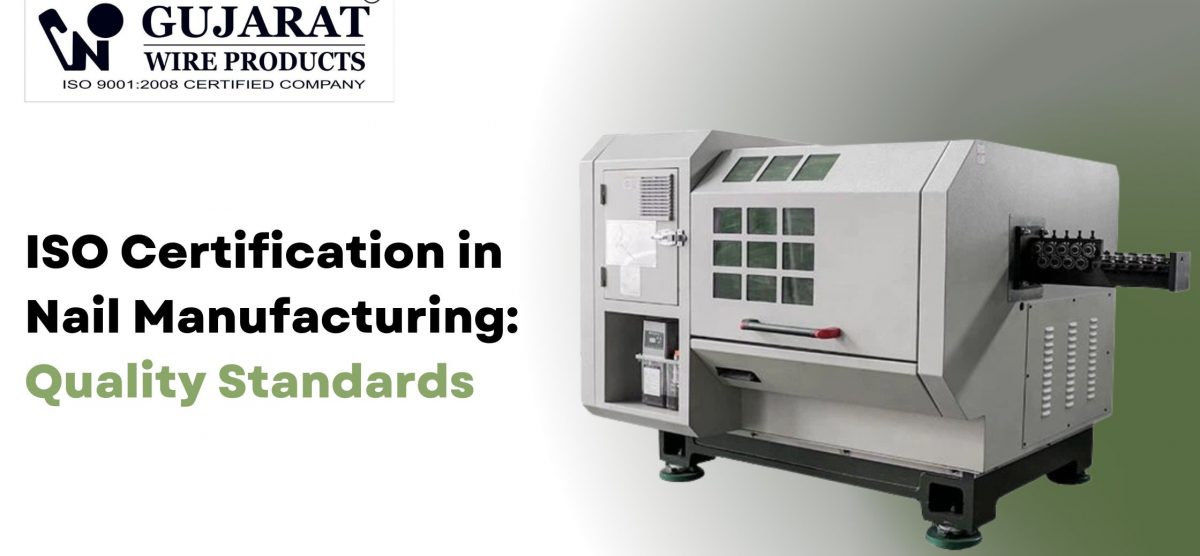
ISO Certification in Nail Manufacturing: Quality Standards
Introduction
Procurement managers at construction companies and export buyers now routinely reject nail suppliers who can’t produce an ISO certification document. That single requirement eliminates a growing share of contract opportunities for nail manufacturers operating without a documented quality management system. The global fastener market—which includes wire nails—exceeded USD 115 billion in 2024, and the shift toward verified quality suppliers accelerates as construction projects face stricter material traceability requirements. ISO 9001:2015 certification doesn’t just signal quality intent. It establishes the documented processes, inspection records, and corrective action systems that produce consistent nail dimensions batch after batch. Plants without it rely on operator experience alone—a system that produces good nails when the right people show up and inconsistent nails when they don’t. This guide covers what ISO 9001:2015 requires in a nail manufacturing context, how certification maps to specific production stages, the concrete business benefits it delivers, and the implementation steps that take a plant from current state to certified.
What is ISO 9001:2015
The Core Framework
ISO 9001:2015 is the internationally recognized standard for quality management systems. It defines requirements for how organizations control processes, manage resources, and respond to nonconformities—not what specific products must look like, but how the system ensuring product consistency must function. Over one million organizations across 170 countries hold ISO 9001 certification, making it the most widely adopted quality framework in global manufacturing.
The 2015 revision added risk-based thinking and leadership accountability requirements that earlier versions lacked. Certified manufacturers must identify quality risks proactively, not just react to defects after they reach customers.
Why ISO 9001 Matters for Nail Manufacturers
Market Access and Buyer Requirements
Export buyers in Europe, the Middle East, and Africa increasingly require ISO 9001 certification as a baseline supplier qualification. Government construction tenders in India and overseas markets specify certified suppliers for structural fasteners. Without certification, nail manufacturers compete only in spot-price commodity markets where margins compress to breaking point.
Here’s the counterintuitive reality: ISO-certified nail manufacturers typically charge 8–12% more than uncertified competitors and still win more contracts—because procurement teams at volume buyers value predictable quality over lowest unit price. A single batch of defective nails returned from an overseas buyer costs more in logistics, rebates, and relationship damage than years of certification maintenance fees.
ISO 9001 in Nail Production Processes
Raw Material Control
ISO 9001 requires documented incoming inspection of all raw materials. For nail manufacturing, this means:
- Wire diameter measurement against specification (±0.1mm tolerance)
- Tensile strength verification by batch certificate
- Surface condition assessment for rust, scale, or coating defects
- Supplier qualification records showing approved wire sources
Incoming inspection records create traceability from finished nail batch back to specific wire coils. When a customer complaint references a specific shipment, the QMS identifies the production date, machine, operator, wire batch, and inspection results within minutes.
In-Process Quality Checks
ISO 9001 mandates defined inspection points within the production process. For nail making lines, these include:
- Dimensional checks every 30 minutes (length, shank diameter, head diameter)
- Head concentricity verification against tolerance limits
- Point geometry assessment using profile templates
- Surface finish inspection for burrs and polishing completeness
Process parameters—machine speed, die condition rating, lubrication status—get recorded alongside inspection results. This data reveals correlations between process variables and quality outcomes that experience-based operations never capture systematically.
Final Inspection and Testing
Every nail batch requires final inspection before release. Standard checks include:
- Statistical sampling per AQL (Acceptable Quality Level) tables
- Tensile pull-out strength testing for structural nail grades
- Corrosion resistance verification for galvanized products
- Packaging integrity and labeling accuracy
Non-conforming batches get quarantined and tagged. The disposition—rework, scrap, or concession—requires documented authorization and root cause investigation before release.
Key Benefits for Nail Manufacturers
Operational Efficiency Gains
ISO implementation forces process documentation that reveals waste invisible to experienced operators. Plants implementing ISO 9001 typically reduce internal defect rates by 20–35% within the first year through systematic root cause analysis rather than reactive troubleshooting. The documentation discipline also accelerates operator training—new employees follow written procedures rather than learning by shadowing experienced colleagues.
Customer Retention Impact
Certified suppliers experience measurably lower customer churn. Documented quality records give buyers confidence that the next shipment will match the last one. Construction contractors who specify nail suppliers by name—rather than buying on spot price—almost exclusively specify certified manufacturers.
Relevant Standards for Nail Producers
Product and Material Standards
ISO 9001 governs the quality system, not the product itself. Nail manufacturers must also comply with product-specific standards depending on target markets:
- ASTM F1667: Wire nail specifications widely used in the US and export markets
- EN 10230: European wire nail standards covering dimensions and tolerances
- IS 723/IS 731: Indian standard specifications for wire nails
- RoHS compliance: Required for zinc-coated and surface-treated nails entering EU markets
ISO 9001 certification makes compliance with these product standards demonstrable—inspection records prove that each batch was checked against the relevant specification, not just manufactured to it.
Implementation Steps
Getting Certified: A Practical Sequence
- Gap analysis: Compare current processes against ISO 9001:2015 requirements. Identify which procedures exist informally and which are entirely absent
- Process documentation: Write quality manual, procedures for key processes, and work instructions for production and inspection tasks
- Training and rollout: Train all production staff on documented procedures. Supervisors need additional training on internal audit techniques
- Internal audit: Conduct a full internal audit against ISO requirements before external assessment. Identify and close nonconformities
- Management review: Senior management reviews audit results, quality objectives, and customer feedback—a formal requirement, not optional
- Certification audit: An accredited certification body conducts a two-stage audit. Stage 1 reviews documentation; Stage 2 assesses implementation in practice
Certification timelines for a nail plant with 20–50 employees typically run 6–12 months from gap analysis to certificate issuance, depending on starting state and implementation pace.
Maintaining ISO Certification
Surveillance and Recertification
ISO 9001 certificates require annual surveillance audits in years one and two, with full recertification every three years. The ongoing audit cycle keeps quality systems active rather than becoming shelf documentation.
Non-conformities identified in surveillance audits must receive documented corrective actions within defined timeframes. Patterns of recurring nonconformity—the same defect type appearing in multiple audits—indicate systemic process failures requiring engineering solutions rather than retraining.
Continuous Improvement Requirements
ISO 9001:2015 explicitly requires continual improvement—not just maintenance of the status quo. Certified manufacturers must set measurable quality objectives, track performance against them, and demonstrate year-on-year improvement in key metrics: defect rates, customer complaints, on-time delivery, and raw material rejection rates.
FAQs
What’s the difference between ISO 9001:2008 and ISO 9001:2015 for nail manufacturers?
ISO 9001:2015 added risk-based thinking, stronger leadership accountability, and explicit supply chain management requirements that 2008 lacked. For nail manufacturers, the practical difference is that 2015 requires documented risk assessments for key production processes and more rigorous supplier evaluation records. Organizations certified to 2008 needed to transition to 2015 by September 2018—2008 certificates are no longer valid.
Does ISO certification cover the machines we use or just our processes?
ISO 9001 certifies your quality management system—the processes, documentation, and controls you use—not specific machines or equipment. However, machine calibration, preventive maintenance records, and equipment suitability assessments are all QMS requirements. Well-maintained, calibrated machines are prerequisite to passing a certification audit.
How much does ISO 9001 certification cost for a nail manufacturing plant?
Certification costs vary by plant size and certification body. For a small-to-medium nail plant, expect consultancy support costs of ₹2–5 lakh, internal training and documentation time of 200–400 person-hours, and certification body fees of ₹1.5–3 lakh for initial audit plus annual surveillance. These costs recover quickly through reduced defect scrap and improved contract win rates.
Can ISO certification help win government tenders for construction materials?
Yes. Government procurement guidelines in India and many export markets specify ISO 9001 as a mandatory qualification for structural fastener suppliers. Tenders specifying certified suppliers automatically exclude uncertified manufacturers regardless of price. Certification converts previously inaccessible tender opportunities into competitive bids.
What happens if we fail the certification audit?
A failed initial audit results in a list of major and minor nonconformities requiring corrective action. Major nonconformities—missing procedures or absent inspection records—require verified correction before certification proceeds. Minor nonconformities allow certification with a commitment to resolve within a defined timeframe. Audit failure is common and recoverable; it identifies specific gaps rather than disqualifying the organization permanently.
Conclusion
ISO 9001:2015 certification gives nail manufacturers documented proof that their quality systems produce consistent output—the evidence export buyers, construction contractors, and government procurement require. Start with a gap analysis to understand your current state, then build the documentation and inspection infrastructure that certification demands. Contact our team today to discuss how ISO-certified machinery supports your quality system implementation from the production floor up.
Gujarat Wire Products has held ISO 9001:2008 certification since establishing its quality management system, supplying nail making machines and wire processing equipment to certified manufacturers across India, Africa, Europe, and Asia. Our machines are built to the same documented quality standards we recommend to customers—calibrated tooling, dimensional inspection records, and traceable component sourcing. We provide technical documentation, calibration support, and process data that integrates directly into your ISO QMS.
Visit gujaratwireproducts.comor contact our engineering team to discuss how our equipment and quality documentation support your ISO 9001 implementation and certification goals