Blog
Automatic Nail Making Machine: A Guide
Most factories that upgrade to automatic nail making machines expect the gain to show up in speed. It does—but the real return shows up somewhere else: in scrap reduction, operator consistency, and the ability to run a second shift without adding headcount. Buyers who focus on nails-per-minute as their primary metric often end up with a machine that hits peak speed for two hours then spends the rest of the shift waiting for die adjustments or wire jams. The selection decision is more complex than the spec sheet suggests. Automatic machines amplify both good setups and bad ones—a poorly matched wire source or a worn cutter creates three times the waste on a 400 nails/min line versus a 120 nails/min semi-auto.
This guide walks through every decision point: machine types, capacity matching, technical specs, real budget figures, tooling, vendor evaluation, and line integration—so you invest in a production asset, not an expensive bottleneck.
What automatic nail machines actually do
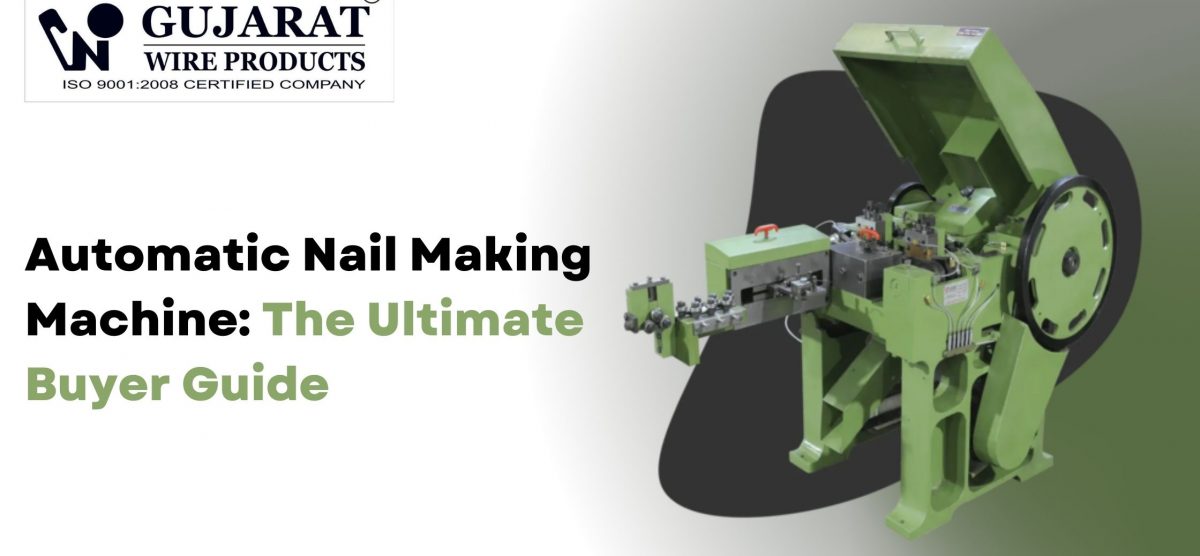
Automatic nail making machines complete the full forming cycle—wire feeding, straightening, heading, cutting, pointing, and ejection—without operator input between cycles. The operator loads wire spools, monitors output quality, and handles scheduled tooling changes. The machine handles everything else.
The key difference from semi-automatic is not just speed. It’s cycle consistency. Automatic machines hold nail length within tighter tolerances, reduce heading variation, and sustain output rates across full shifts without operator fatigue affecting quality.
Machine types and configurations
Not all automatic machines are built for the same job. Match the type to your dominant product before shortlisting models.
- Standard automatic: Common wire nails, 25–100mm length, cam-driven forming cycle
- High-speed automatic: 400–800+ nails/min, servo or variable frequency drives, PLC controls
- Specialized automatic: Concrete nails, ring shank, coil nails—require dedicated forming geometry
- Integrated line: Machine bundled with wire drawing, polishing, and auto-packaging
A useful pattern from large buyers: factories producing 70% of their volume in two or three nail sizes consistently outperform flexible-setup competitors on cost-per-nail. Dedicated automatic lines tuned to narrow size bands beat “do-everything” configurations on uptime and scrap.
Capacity and output matching
Matching speed to real demand
Automatic machine speed ranges roughly as follows:
- Entry automatic: 150–250 nails/min (small and growing workshops)
- Standard automatic: 200–300 nails/min (mid-size regional producers)
- High-speed automatic: 400–800+ nails/min (commercial and export-scale lines)
Here’s the contrarian finding that buyers consistently ignore: factories that run machines at 70–75% of rated speed with under 2% scrap produce more saleable nails per shift than those pushing 95% speed with 5–6% scrap. Over-driving an automatic line to hit peak numbers is the fastest way to accelerate die wear and increase breakdown frequency.
When to move from semi-auto to automatic
The upgrade decision becomes clear-cut when three things coincide:
- Daily demand regularly exceeds 200–300 kg and semi-auto output creates backlogs
- Operators spend more time clearing jams and resetting lengths than producing
- Wire scrap from inconsistent manual adjustments crosses 3–4% of total input
Technical specifications checklist
Focus on specs that affect daily performance, not just catalogue appeal.
- Wire diameter range: Confirm it covers your current product mix with room for one additional SKU
- Nails per minute at your specific nail length: Ask for documented performance at your size, not the machine’s maximum
- Motor power and drive type: Variable frequency drives cut wire waste on small batches
- Control system: PLC-based length and speed adjustment simplifies changeovers and repeat setups
- Lubrication system: Centralized timed lubrication outperforms manual greasing on uptime and bearing life
- Safety compliance: Guards, interlocks, and emergency stops—non-negotiable for any serious production floor
Budget and real cost breakdown
Published market data puts standard automatic machines in the USD 9,000–14,000 range for 200–300 nails/min capacity. That figure covers the machine only. A complete production line adds:
- Wire drawing machine (if not sourcing pre-drawn wire externally)
- Polishing drum sized to match nail machine output
- Heading dies, cutting knives, and spare tooling set
- Installation, commissioning, and operator training
- Initial spare parts stock: knives, springs, sensors, belts
An uncomfortable pattern reported across buyer surveys: factories that prioritise the lowest machine price and skip spare-parts budgeting typically spend more on unplanned downtime within 18 months than the cost difference they saved upfront.
Tooling and maintenance planning
Automatic machines multiply the impact of tooling quality. A worn cutter on a slow semi-auto machine produces a few hundred defective nails before the operator catches it. The same worn cutter on a 300 nails/min automatic line scraps thousands of nails per hour.
Plan for:
- Scheduled die and cutter grinding at defined intervals—not reactive replacement after quality drops
- Centralized lubrication checks at every shift start
- Stock of critical spares on-site: knives, heading dies, springs, and cam followers
- A documented changeover procedure so length adjustments between batches take under 20 minutes
High-volume producers use a simple benchmark during vendor trials: the machine must sustain 92% of planned output with scrap under 1.5% over a 72-hour run. If it can’t clear that bar during evaluation, it won’t clear it in production.
Vendor evaluation criteria
For automatic machines, vendor capability matters as much as machine specification. Evaluate suppliers on:
- Documented performance data on your exact nail sizes and wire diameter
- Regional technician availability and spare parts lead times
- Quality of technical documentation, training support, and commissioning
- Warranty terms and clarity of service commitments post-installation
The most practical selection approach is a structured sequence: audit your current output gaps, shortlist two or three vendors, visit factories, run a supervised trial at your facility, then finalize. Even on compressed timelines, following the sequence—not skipping vendor visits or factory trials—prevents the majority of post-purchase problems.
Line integration and compatibility
An automatic nail machine running at 300 nails/min creates upstream and downstream pressure. Check compatibility before committing:
- Does your wire source consistently hit the diameter tolerance the machine needs (±0.05mm)?
- Can your polishing and packing throughput keep pace with the new output volume?
- Does the machine footprint, power requirement, and material flow fit your shop floor layout?
Factories that upgrade the nail machine without adjusting the wire drawing or polishing stages typically see the new machine run at 50–60% utilization—bottlenecked by what comes before and after it.
FAQs
Can one automatic machine handle multiple nail sizes without a full die changeover?
Within a narrow wire diameter range (typically ±0.5mm), length adjustment is usually mechanical and fast. Moving across a wide diameter range—say from 2mm to 4mm wire—requires heading die and cutter changes, which takes 30–60 minutes on most machines. Plan your SKU mix around two or three wire diameters to minimize changeover time.
What wire specification does an automatic nail machine require?
Low carbon steel wire (Q195 or SAE 1008), tensile strength 350–450 MPa, diameter variation within ±0.05mm. Higher carbon content accelerates heading die wear. Diameter variation above ±0.1mm causes feeding jams that interrupt automatic cycles and look like mechanical faults but are actually a wire quality problem.
How do I evaluate output claims from machine suppliers?
Ask for a live demonstration at your target nail length, not the machine’s maximum speed rating. Record actual nails per minute, scrap count, and any stoppages over a minimum two-hour run. Claimed catalogue speeds are typically measured on smaller nail sizes under ideal conditions.
What causes heading defects on automatic machines?
Misaligned heading dies, worn punch faces, or wire diameter inconsistency. Heading defects appear progressively—first as slight off-center heads, then as cracked or split heads. Catching the early signs and correcting die alignment immediately prevents a minor tooling issue from becoming a full die replacement.
Choose the machine that fits your system, not just your budget
Buying an automatic nail making machine means committing to a production rate, a tooling maintenance cycle, a wire supply standard, and a vendor relationship—simultaneously. The machine spec is just one variable. Get the capacity match, line integration, and vendor support right, and your automatic line runs predictably for years. Get any one of those wrong, and no amount of raw speed recovers the loss.
Gujarat Wire Products manufactures automatic nail making machines, wire drawing equipment, and polishing systems as matched production packages—built in Rajkot and backed by on-site commissioning, training, and fast-turnaround spare parts from our factory team.
Ready to evaluate an automatic nail making line for your production targets? Visit
or contact our technical team for a capacity assessment and machine recommendation based on your nail sizes, daily output goals, and existing equipment.