Blog
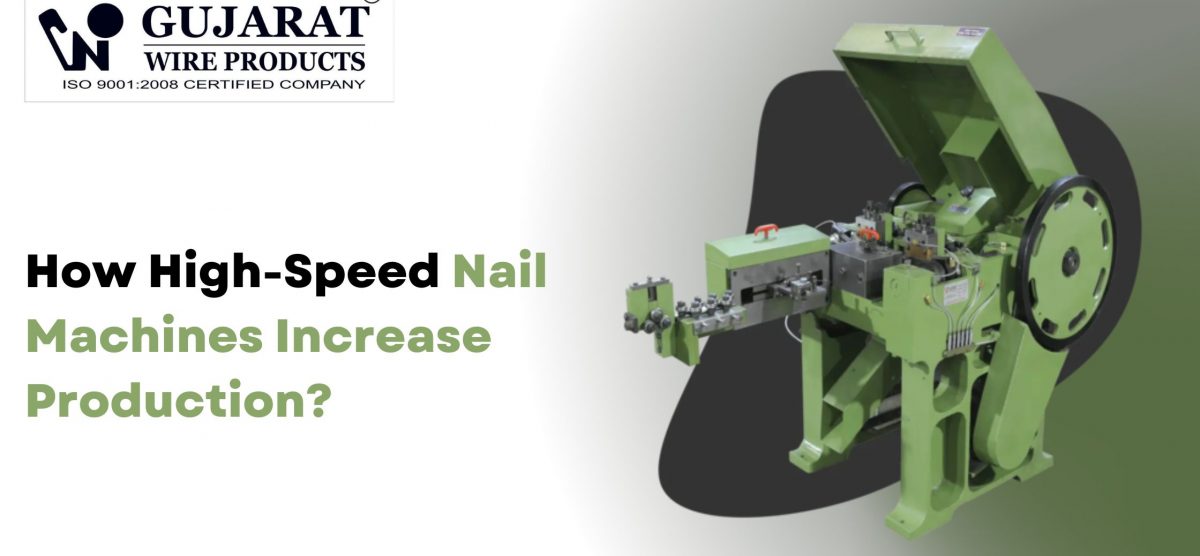
How High-Speed Nail Machines Increase Production?
Introduction
Conventional nail machines hit a ceiling that no amount of maintenance or tuning can break through. A reciprocating cut-and-head machine running 300–400 nails per minute cannot simply be made faster—its mechanical design imposes a hard limit on cycle rate, and pushing beyond it accelerates wear and raises rejects simultaneously. Yet most nail plants in India are still running on exactly this principle, losing capacity not to machine failure but to architectural constraints built into equipment that was never designed for today’s volume demands. The high-speed nail machine market was valued at $1.8 billion in 2025 and is growing at 6.2% CAGR globally —driven precisely by manufacturers who discovered that switching machine architecture, not just upgrading motors, is what actually scales output. This guide explains how high-speed machines work, where the production gains come from, what features drive them, and the operational triggers that tell you the upgrade is no longer optional.
How High-Speed Machines Work
Rotary Forming vs. Conventional Hammering
Conventional machines form one nail per hammer stroke—feed, clamp, punch, release, repeat. Each cycle includes a deceleration and reversal phase that limits how fast the sequence can run before timing errors, die misalignment, and vibration accumulate.
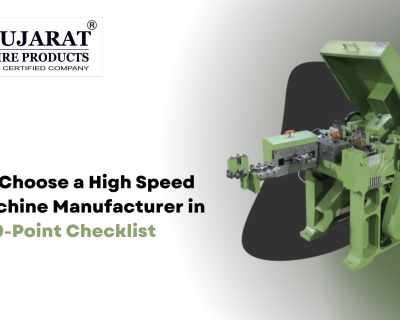
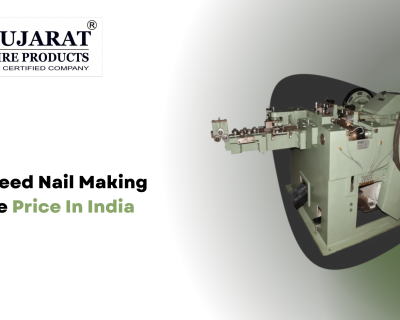
High-speed machines use rotary forming principles where wire feeds continuously into a rotating forming head. There is no deceleration-and-reversal motion. The wire straightens, cuts, heads, and points in one continuous flow—which is why cycle rates of 800 to 2,500 nails per minute are achievable without the mechanical stress that limits reciprocating designs.
Production Gains
High-speed machines increase effective output through three simultaneous mechanisms:
- Higher cycle rates: 800–2,500 nails per minute versus 300–450 on conventional machines—a 2× to 5× increase depending on nail size and model
- Shift consistency: Rotary forming generates lower peak mechanical stress per cycle, so machines maintain timing and alignment across 16-hour shifts without the gradual drift that cuts conventional machine output by 20–30% over a full day
- Floor space efficiency: One high-speed machine producing 1,200 nails per minute uses roughly the same footprint as two conventional machines producing a combined 700—halving the facility cost per ton of output
The contrarian insight most buyers miss: the production gain isn’t mainly about peak speed. It’s about sustained output per shift. A machine that loses 25% capacity by hour ten costs more in daily tonnage than its rated speed suggests.
Quality Gains
Tighter Tolerances at Higher Speeds
Rotary forming applies uniform force through continuous motion rather than impact cycles. This keeps head centering within ±0.1mm and length variation below ±0.3mm across full production batches—tolerances that conventional machines at high speed cannot maintain as dies and timing components wear.
Real-time monitoring systems on advanced high-speed models track wire tension, head formation, and output dimensions continuously. A die alignment drift of 0.05mm triggers an alert before it produces thousands of out-of-spec nails—rather than after a batch rejection discovers the problem.
Labour and Operating Gains
One trained operator supervises two to three high-speed machines simultaneously. On conventional machines requiring frequent jam clearing, manual tension adjustment, and per-machine visual checks, that ratio drops to one-to-one. At 30 tons monthly production, this difference cuts direct labour cost per ton by 50–60%.
Digital interfaces on modern high-speed machines store parameter sets for each nail specification. Size changeovers load saved settings rather than requiring manual recalibration—compressing changeover time from 45–60 minutes to 15–20 minutes and making mixed-size production schedules practical.
Features That Drive Higher Output
The production gains come from engineering built into the machine design itself:
- Automatic lubrication systems running on programmed intervals—eliminating manual greasing dependency that causes the majority of bearing failures on conventional machines
- PLC control with variable frequency drives for real-time speed adjustment and overload protection without manual intervention
- Multi-point fault detection: wire break, overload, low oil, and die jam sensors stop production before damage spreads to adjacent components
- Inline compatibility with conveyors, polishing drums, weighing stations, and collating lines—matching downstream equipment to forming speed without bottlenecks
- Dual punch die structures on advanced models that double effective output without increasing machine footprint
Where the Gains Show Up
Production improvements from high-speed machines concentrate in four measurable areas:
- Daily tonnage per square metre increases because higher output from a smaller footprint compresses facility cost per unit
- Order fulfilment speed improves because sustained output matches or exceeds customer lead time expectations without extended shifts
- Downtime drops because fault alarms and real-time monitoring catch developing problems before they become stoppages—cutting unplanned downtime by 60–70% versus reactive maintenance patterns on older equipment
- Yield improves because tighter dimensional control reduces first-pass reject rates from 4–6% on worn conventional machines to under 2% on calibrated high-speed equipment
When to Upgrade
Four operational patterns confirm the upgrade timing has passed:
- Demand exceeds capacity: Current machines cannot increase daily tonnage without adding more units and proportionally more operators and floor space
- Rejects rise with speed: Conventional machines pushed above 70% of rated capacity show reject rates climbing above 3–5% as timing drift and die wear compound
- Labour costs rising per ton: Adding shifts or operators to compensate for machine limitations signals the equipment—not the workforce—is the constraint
- Customer specifications tightening: When clients specify dimensional tolerances, surface finish, or head geometry that conventional machines at production speed cannot consistently meet
FAQs
How much faster are high-speed machines than conventional models in real production?
High-speed machines deliver 800 to 2,500 nails per minute in sustained production versus 300–450 for conventional reciprocating machines. The practical gap widens across full shifts as conventional machines lose timing consistency while high-speed rotary designs maintain output rates. Reduce any rated speed by 20–25% to estimate real sustained production for your specific nail size.
Do high-speed machines need fewer operators?
Yes—typically one operator per two to three machines due to automated lubrication, fault detection, and digital parameter storage reducing manual intervention requirements. Operator skill requirements shift from hands-on mechanical adjustment to monitoring, quality verification, and parameter management.
What quality improvements come with higher speed?
Head centering tolerances hold within ±0.1mm and length variation below ±0.3mm across full batches—tighter than conventional machines can sustain at production speed. Real-time monitoring catches dimensional drift before batch rejection occurs, reducing the material waste that conventional machines generate through gradual, undetected quality degradation.
Can high-speed machines integrate into automated production lines?
Yes, when output speed matches downstream polishing, weighing, and packing equipment capacity. Line integration planning must confirm all downstream equipment handles peak forming output without creating bottlenecks. High-speed machines with adjustable output speed settings make this matching process more flexible than fixed-rate conventional designs.
Conclusion
High-speed nail machines increase production by changing the architectural principle of forming—not just the motor size or cycle timing. The gains in sustained output, labour efficiency, quality consistency, and floor space utilisation compound across every production shift, making the upgrade economics straightforward once current machine limitations are measured accurately.
Gujarat Wire Products engineers high-speed nail machines designed for Indian production environments—variable power supply, extended shift demands, and diverse nail portfolios. Our machines deliver the sustained output rates, fault detection systems, and integrated line compatibility that turn high-speed production from a catalog claim into a daily operational reality. Ready to see what high-speed production changes in your plant? Visit gujaratwireproducts.com and share your current output figures, nail range, and shift structure for a direct performance comparison and machine recommendation from our engineering team.