Blog
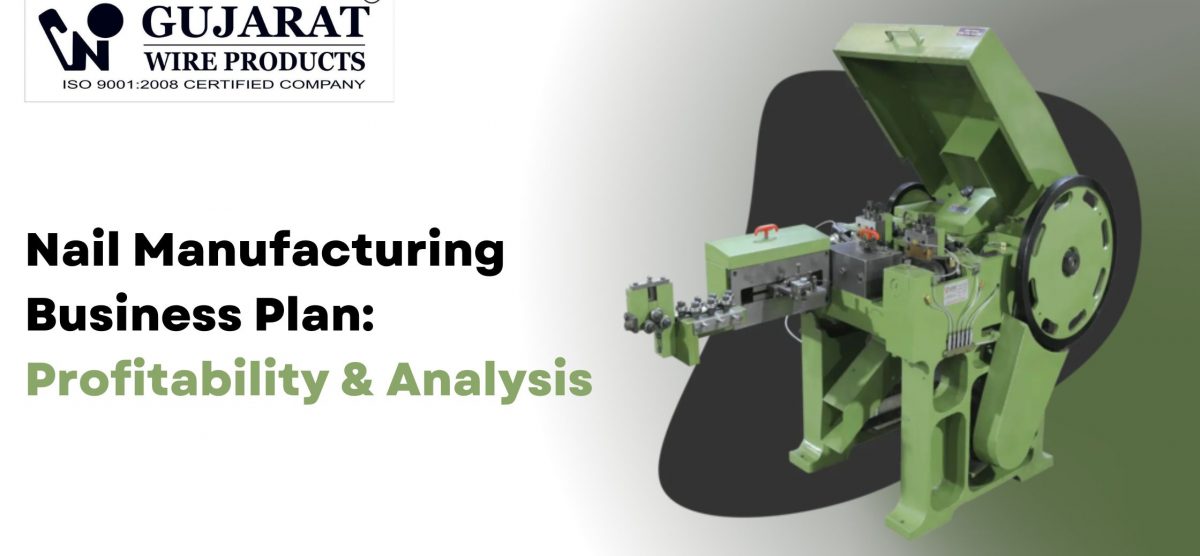
Nail Manufacturing Business Plan: Profitability & Analysis
Most people who research nail manufacturing focus on machines first and business fundamentals second. They price one machine, calculate a rough output figure, assume steady demand, and call it a plan. That approach explains why a significant share of small nail operations struggle within 18 months—not because nails stop selling, but because the cost structure was never modelled against real margins, real raw material volatility, or real machine downtime. Nail manufacturing is a genuine small-to-mid-scale industrial opportunity with predictable demand, a short production cycle, and relatively low barriers to entry. But profitability depends entirely on how well you match production capacity to market volume, control raw material costs, and keep equipment running. This guide covers the complete business picture: market demand, startup requirements, cost structure, profitability mechanics, break-even analysis, sales channels, and the risks that most business plans underestimate. Work through each section and you’ll have a foundation solid enough to finance, execute, and grow.
Market demand and opportunity
Construction drives nail demand. Residential housing, commercial fit-outs, furniture manufacturing, timber packaging, and infrastructure maintenance all consume nails continuously. Demand is not cyclical in the way consumer goods are—construction activity in India has grown steadily, and imports of basic hardware like nails remain expensive relative to locally manufactured alternatives.
The underappreciated market reality: most construction materials wholesalers prefer local suppliers for nails specifically because lead times matter and nails are bought in bulk. A reliable local producer with consistent quality and same-week delivery holds an advantage that distant manufacturers—even cheaper ones—cannot easily overcome.
Business model and product positioning
Choosing your scale
Three viable entry points exist:
- Small scale: 50–150 kg/day; one semi-automatic machine; serves local hardware shops and small contractors
- Mid scale: 200–500 kg/day; one or two automatic machines; serves regional wholesalers and building material dealers
- Large scale: 500+ kg/day; multiple automatic lines; targets export, large distributors, and institutional buyers
Start at the scale where your confirmed order pipeline justifies the fixed costs—not the scale where your growth ambition does.
Product mix decision
Common wire nails (1.5″–4″) account for the bulk of volume in most markets. Concrete nails and galvanized nails carry higher margins but require different wire grades and finishing steps. Most profitable small operations start with two or three standard sizes, dominate those, and add specialty products only after the base line is cash-flow positive.
Startup requirements
Space and infrastructure
A functional small-to-mid scale nail plant needs:
- Factory floor: 1,500–2,500 sq ft minimum for machines, material flow, and storage
- Three-phase power supply: 15–30 kW depending on machine count
- Ventilation and lighting adequate for metalworking
Workforce
A single automatic nail line with wire drawing runs on 2–3 operators per shift. Maintenance needs one trained technician, either full-time or shared across lines. Training cost is low; retention is the actual variable to plan for.
Machinery and equipment
A complete production line includes:
- Wire drawing machine (to convert rod to nail wire in-house)
- Automatic nail making machine matched to your target size range
- Polishing drum for surface finishing
- Cutter grinder and die tools for in-house tooling maintenance
Buying piecemeal from separate vendors adds integration risk. Machines built to work together—matched on speed, wire diameter range, and control compatibility—reduce commissioning time and ongoing maintenance friction.
Cost analysis
Fixed costs
- Machinery and installation
- Factory lease or purchase
- Initial tooling and spare parts stock
- Licenses, registration, and working capital reserve
Variable costs
- Wire rod: typically 70–75% of total production cost—the dominant variable
- Electricity: 8–12% depending on machine type and draw speed
- Labor: 5–10%
- Tooling wear (knives, dies): 3–5%
- Packaging and logistics: 2–4%
The uncomfortable finding: most first-time operators underestimate wire rod cost volatility. Steel prices fluctuate 10–20% across quarters. Producers who lock in wire rod supply contracts at fixed prices—even at slight premium—consistently outperform spot buyers on margin stability.
Profitability analysis
Revenue and margin structure
Nail selling prices vary by size, grade, and market. Common nails in India typically trade at ₹55–80 per kg retail and ₹45–65 per kg wholesale, depending on region and size. Wire rod input cost at ₹45,000–55,000 per tonne means the per-kg material cost runs ₹45–55 before conversion.
Gross margins at wholesale pricing typically fall in the 15–25% range for commodity sizes. Specialty nails (concrete, galvanized, ring shank) push margins to 30–40% but require capital for additional equipment.
Break-even analysis
Break-even volume depends on your fixed cost base. A typical small-scale setup (one automatic line, leased space) reaches break-even between 80–120 kg per day of actual saleable output. The key variable is machine utilization—a line running at 60% utilization due to wire jams, tooling changes, and unplanned downtime may never cover fixed costs. Uptime is not a maintenance metric; it’s a profitability metric.
Payback period
Small-scale operations with controlled costs and a confirmed local buyer base report payback periods of 18–36 months on full capital investment. Operations that skip in-house wire drawing and buy pre-drawn wire consistently show longer payback periods despite lower initial capital, because wire cost per kg is significantly higher without the drawing step.
Sales and marketing plan
Distribution channels
- Hardware wholesalers: Highest volume, lowest margin; builds base utilization fast
- Building material dealers: Medium volume, slightly better margin; relationship-driven
- Direct to contractors: Best margin; requires consistent volume commitment and credit management
- Export: Viable above 500 kg/day; needs documentation, quality certification, and reliable logistics
Building repeat demand
Nail buyers reorder constantly and switch suppliers primarily on two factors: delivery reliability and price consistency. Producers who meet delivery windows and hold pricing stable for 30–60-day periods build sticky buyer relationships faster than those competing purely on lowest price.
Risks and challenges
Plan for these specifically—they end more nail businesses than competition does:
- Wire rod price spikes: Hold 30–45 days of wire inventory as a buffer when prices are stable
- Machine downtime: A line that stops for three days waiting for a spare knife loses more than the spare cost; stock critical tooling on-site
- Quality rejection: Inconsistent wire diameter or wrong steel grade creates reject batches that damage buyer relationships quickly
- Undercapitalization: Starting without 90 days of working capital reserve forces reactive decisions on raw material buying and maintenance that compound into margin erosion
FAQs
How much capital does a small nail manufacturing unit require to start?
A functional small-scale setup (one semi-automatic machine, wire drawing, polishing, and 60 days of working capital) typically requires ₹15–30 lakh depending on machine quality, space costs, and initial wire inventory. Skipping wire drawing to reduce upfront cost usually adds more to ongoing wire cost than the saving is worth.
Is GST registration required for nail manufacturing in India?
Yes. Nail manufacturing is a manufacturing activity and requires GST registration once turnover crosses the applicable threshold. Most banks also require GST registration for equipment loan processing. Register before approaching equipment financing, not after.
Can nail manufacturing be started from a rural or semi-urban location?
Yes, and it often makes economic sense. Land and labor costs are lower, three-phase power is available in most industrial zones, and proximity to local construction markets reduces logistics costs. The primary requirement is road access for wire rod delivery and finished goods dispatch.
What certifications does a nail manufacturer need in India?
At minimum: factory registration under the Factories Act, GST registration, and MSME registration for government scheme access. BIS certification (IS 723) is required to sell wire nails under the Bureau of Indian Standards mark, which larger buyers and export customers increasingly require.
Plan the line before you buy the machine
A nail manufacturing business that works starts with a mapped cost structure, a confirmed buyer segment, and equipment sized to actual demand—not theoretical maximum output. The machine is one component. Raw material sourcing, tooling maintenance, sales channel development, and working capital management determine whether the line pays for itself or sits underutilized.
Gujarat Wire Products manufactures wire drawing machines, automatic nail making machines, and polishing equipment as matched production packages—built in Rajkot and backed by technical guidance on wire specs, production planning, and commissioning support so your line starts producing from day one.
Planning a nail manufacturing setup? Visit gujaratwireproducts.com or contact our team for an equipment recommendation and production capacity assessment based on your target output, nail sizes, and budget.