Blog
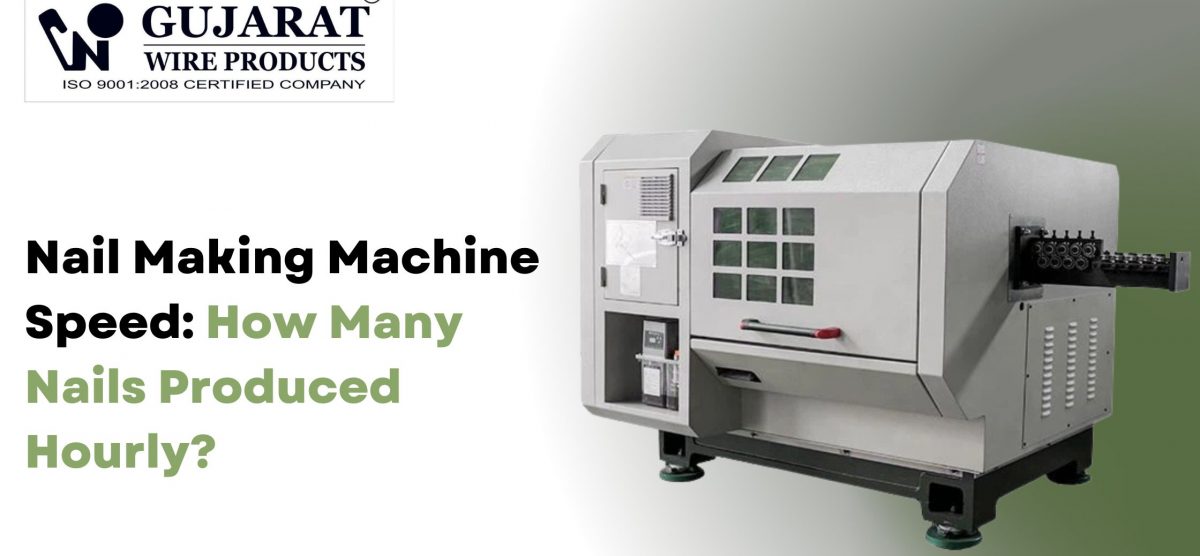
Nail Making Machine Speed: How Many Nails Produced Hourly?
Buyers comparing nail making machines almost always anchor on nails-per-minute figures from brochures. That number is the least useful data point for production planning. A machine rated at 600 nails per minute doesn’t produce 36,000 nails per hour in a real factory—changeovers, brief stoppages, wire variability, and tooling wear consistently bring effective hourly output 15–30% below the rated figure. The gap matters because sizing a production unit, planning wire procurement, and quoting delivery timelines all depend on actual output, not theoretical maximums. This guide explains what speed ratings actually mean, how to calculate realistic hourly and shift-level output for any machine class, what factors push output up or down in live production, and how to match machine speed to your specific nail mix and daily demand. You’ll leave with a working method for evaluating any nail machine on production terms that reflect your actual operating conditions.
Speed Ranges by Machine Type
Not all machines operate in the same output band. Knowing which class fits your volume requirement eliminates the wrong options before you evaluate anything else.
Entry-Level and Standard Machines
Standard mechanical cam-driven machines typically run at 100–300 nails per minute. Over an 8-hour shift at 85% efficiency, that delivers 51,000–153,000 nails. These machines suit small workshops producing mixed nail sizes in moderate daily volumes where simplicity and low maintenance cost outweigh speed.
Mid-Range Automatic Machines
Mid-range fully automatic machines operate in the 300–500 nails per minute band. At 85% shift efficiency, expect 153,000–255,000 nails per 8-hour shift. This class suits operations with consistent nail specifications and stable daily demand where PLC controls deliver better quality than cam-only systems.
High-Speed Automatic Machines
High-speed machines produce 600–800 nails per minute under rated conditions. Some systems claim over 1,000 nails per minute. At 75–80% real-world efficiency—typical for high-speed lines with wire variability—an 800 nails/min machine delivers 360,000–384,000 nails per 8-hour shift, not the brochure’s 480,000. Plan with the lower figure.
Rotary and Ultra-High-Speed Systems
Rotary die systems push beyond 800 nails per minute by replacing reciprocating action with continuous rotation, reducing vibration and mechanical stress at top speed. These suit large integrated lines where wire drawing, forming, polishing, and collation are all sized to match. At this output level, any bottleneck elsewhere in the line limits effective speed regardless of the machine’s rated capacity.
How to Calculate Hourly Output
Basic Formula
The conversion is straightforward:
- Nails per minute × 60 = rated hourly output
- Rated hourly output × efficiency factor = realistic hourly output
- Realistic hourly output × operating hours = shift output
Real-World Efficiency Adjustment
Use 85% efficiency for standard and mid-range machines under good operating conditions. Apply 75–80% for high-speed machines where wire variability and changeovers have larger impact. A machine rated at 500 nails/min therefore delivers approximately 25,500 nails/hour under real conditions, not the 30,000 the rating implies.
This efficiency gap is where most capacity planning mistakes happen. Operators who plan at 100% rated capacity consistently miss delivery commitments and run emergency shifts to compensate.
Output by Nail Size
Smaller nails allow higher cycle speeds because less wire feeds per cycle and heading force is lower. Larger nails—longer length, thicker gauge—require the machine to slow down for stable head formation and accurate cutting. A machine rated at 600 nails/min on 1.5-inch nails may only deliver 400 nails/min on 4-inch nails. Always confirm the rated speed at your target nail size, not the machine’s maximum across all sizes.
What Affects Hourly Output
Wire Quality and Feed Consistency
Clean, uniform-diameter wire feeds smoothly and supports stable cycle rates. Wire with diameter variation or surface rust causes feed hesitations, micro-stoppages, and jams that reduce hourly output cumulatively over a shift. Operators who invest in wire quality control upstream recover more speed from their nail machines than those who tune machine settings trying to compensate for poor wire.
Machine Design and Controls
Cam-driven machines have fixed speed ceilings determined by mechanical balance. PLC-controlled machines with servo drives and optical sensors maintain output stability at high speeds by detecting feed errors and adjusting in real time. Sensors that trigger automatic shutdown on wire disorder protect tooling and prevent defect runs—this matters at high speed where a jam causes damage in milliseconds.
Tooling Wear and Maintenance
New dies and cutters produce consistent nails at rated speed. As tooling wears, scrap rates climb and operators instinctively reduce machine speed to compensate—reducing effective hourly output without addressing the root cause. Reconditioning dies on a scheduled cycle maintains output more reliably than running to failure and replacing.
Choosing the Right Speed Range
Match Speed to Daily Demand
Size your machine to run at 70–85% of rated capacity at your target daily tonnage. Operating a machine continuously near its rated maximum accelerates wear and reduces tooling life.
Practical bands:
- Small scale (up to 50 kg/day): 100–300 nails/min machines
- Medium scale (50–150 kg/day): 300–500 nails/min machines
- Commercial scale (150 kg+/day): 600–800+ nails/min machines
Match Speed to Your Full Line
A nail machine running at 600 nails/min can’t sustain that rate if wire drawing capacity only feeds 400 nails/min worth of wire. Line output equals the slowest stage, not the fastest machine. Size wire drawing, polishing, and packing capacity proportionally before buying a high-speed machine.
Match Speed to Labor and Power
High-speed machines need stable three-phase power and operators who can diagnose PLC faults. Voltage fluctuation above ±5% affects servo drive performance and reduces effective speed. Confirm your power supply quality before specifying a high-speed machine.
FAQs
Why does my machine produce fewer nails per hour than the spec sheet claims?
Efficiency losses from changeovers, brief stoppages, wire variability, and operator adjustments consistently reduce real output below rated figures. Plan with 75–85% of rated capacity depending on machine class and operating conditions. Request a reference site visit to see actual shift output before buying.
Does nail length affect speed and hourly output?
Significantly. Longer nails require more wire per cycle and higher heading force, which limits safe cycle rate. A machine rated at 600 nails/min on short nails may run at 350–400 nails/min on longer sizes. Always confirm rated speed at your specific nail length and wire diameter.
How many shifts do I need to hit a daily tonnage target?
Divide your daily tonnage target by the weight per nail at your specification, then by realistic hourly output to get operating hours required. Most medium-scale operations achieve targets in 1.5–2 shifts. Adding a second full shift is often more cost-effective than buying a higher-speed machine.
Can I increase output on my existing machine?
Yes, within limits. Ensure wire quality is consistent, tooling is sharp and aligned, and lubrication systems are functioning. These three factors alone can recover 10–15% of lost output on underperforming machines before any mechanical modification.
Conclusion
Hourly output planning requires rated speed, realistic efficiency factors, nail size adjustments, and line balance—not the top number on a brochure. Calculate your actual shift output before committing to any machine configuration. Contact us today for a capacity assessment matched to your nail mix, daily tonnage target, and existing line setup.
Gujarat Wire Products supplies nail making machines across every speed class—from standard 100–300 nails/min units to high-speed 600–800 nails/min automatic lines—built and calibrated for Indian wire specifications and operating conditions. We calculate realistic hourly and shift-level output for your specific nail sizes before recommending any machine, so your production planning reflects what the line actually delivers. Our commissioning team tunes speed settings, wire feed alignment, and tooling calibration at installation to ensure you hit output targets from the first shift. Visit gujaratwireproducts.com or call us directly to get a capacity analysis and matched machine recommendation for your nail production needs.