Blog
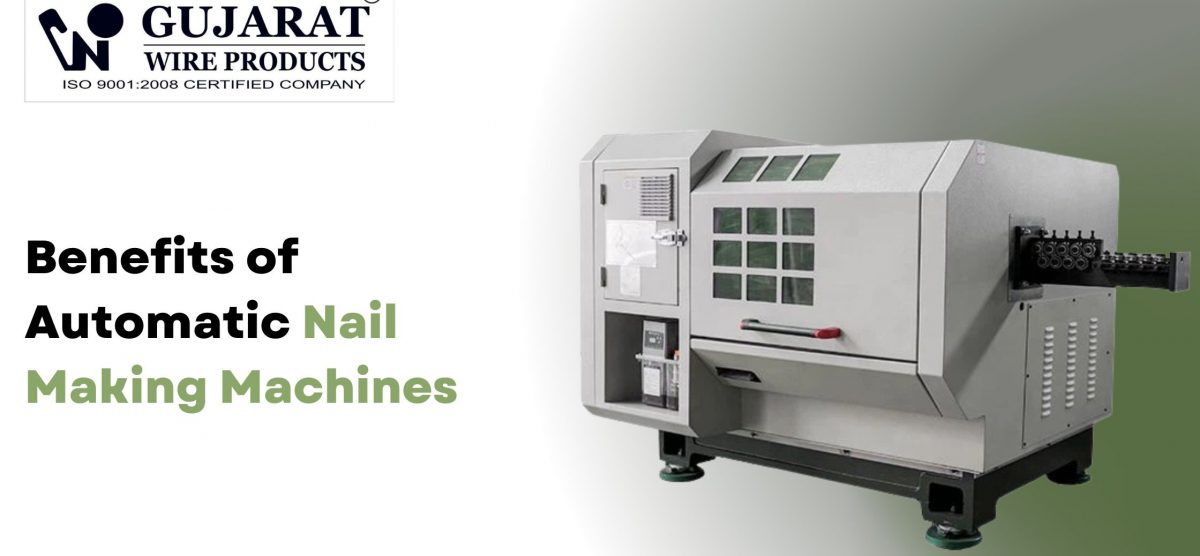
Benefits of Automatic Nail Making Machines
Introduction
Manual nail production hits a ceiling fast. One operator managing a semi-automatic machine produces roughly 80–120 kg of finished nails per shift—enough for a local hardware shop, not enough for a construction contractor placing monthly orders in tonnes. The moment demand outpaces manual capacity, manufacturers face a choice: hire more people and multiply labor costs, or switch to automatic equipment that runs at 300–500 nails per minute with one operator overseeing multiple machines. The global automatic nail making machine market grows at 6.1% CAGR, driven by construction booms across India, Africa, and Southeast Asia where consistent nail supply at scale determines which manufacturers win large contracts. Automatic machines don’t just make nails faster—they fundamentally change the unit economics of nail production. This guide covers every meaningful advantage: output rates, quality consistency, labor savings, cost per kg, plant setup, product flexibility, operator safety, waste reduction, and business scaling. Each benefit maps to a specific production reality that manual or semi-automatic setups can’t match.
Production Speed and Volume
Sustained Output at Scale
Automatic nail machines produce 300–500 nails per minute continuously, translating to 800–1,200 kg of finished nails per eight-hour shift depending on nail size. Semi-automatic machines managed by a skilled operator reach 80–120 kg per shift. That four-to-ten-times output gap determines which suppliers can serve construction and pallet manufacturing contracts requiring consistent weekly tonnage.
Running three shifts with automatic equipment produces 2,400–3,600 kg daily from a single machine. One operator monitors multiple machines simultaneously—a labor efficiency that manual production can never replicate.
Quality and Consistency
Uniform Output Across Every Batch
Automatic machines hold dimensional tolerances within ±0.5mm for length and ±0.3mm for head diameter across full production shifts. Manual and semi-automatic setups drift as operators fatigue—head concentricity degrades, length variance creeps up, and defect rates climb through the second half of every shift. The uncomfortable fact: most nail quality complaints trace to the last two hours of a manual production shift, not equipment failure.
Consistent die geometry and controlled feed tension produce nails with identical point sharpness, shank straightness, and head geometry batch after batch. Buyers operating pneumatic nailers particularly value this—dimensional inconsistency jams automated tools and creates costly site stoppages.
Labor Savings and Staffing
Fewer Operators, Lower Overheads
One trained operator manages two to three automatic machines simultaneously. The same output from manual production requires four to six operators performing repetitive loading, monitoring, and collection tasks. Labor cost savings per tonne of output typically exceed the machine’s financing cost within the first 18 months of operation.
Training timelines also compress. Documented automatic machine procedures take three to five days to master versus weeks of hands-on skill development for consistent manual production.
Cost Efficiency and ROI
Production Cost Per Kg
Automatic machines reduce production cost per tonne by 40–60% compared to manual setups, primarily through labor reduction and lower defect scrap rates. Energy consumption per tonne drops too—modern automatic machines with VFD drives consume 40–60 kWh per tonne versus 70–90 kWh for older fixed-speed equipment. Track cost per kg weekly to see the compounding effect of consistent uptime against fixed overhead.
Space and Plant Setup
Compact and Integrated Footprint
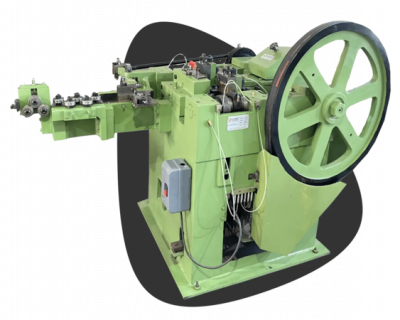
Standard automatic nail machines occupy 1,600mm × 1,550mm floor space—smaller than most buyers expect for the output volume they deliver. A complete production line including wire uncoiler, nail machine, and polishing drum fits within 25–30 square meters. This compact footprint makes automatic production accessible for MSME plants with limited floor area, not just large factories.
Versatility and Product Range
Multi-Size Production on One Machine
Automatic machines switch between nail sizes through cutter adjustment and die changes, typically completed in 15–20 minutes with documented procedures. A single machine covers the 1–4 inch construction nail range plus roofing and finishing nails. This flexibility lets manufacturers serve multiple customer segments—construction contractors, pallet manufacturers, and furniture factories—from one production unit without dedicated equipment for each nail type.
Safety and Operational Ease
Enclosed Mechanisms Protect Operators
High-speed enclosed automatic machines reduce operating noise from 85–90 dB to 72–78 dB, dropping below mandatory hearing protection thresholds for single-machine operations. Enclosed frames contain metal fragments within the cutting zone rather than projecting them into operator space. Safety interlocks stop the machine when guards open—a protection layer that semi-automatic designs rarely include.
Simple HMI controls and automatic lubrication systems reduce the technical skill required for daily operation. Operators monitor output quality rather than managing complex manual adjustments throughout the shift.
Sustainability and Waste Reduction
Better Material Yield and Energy Use
Precise automatic feed mechanisms waste less wire per nail than manual feeding. Scrap rates below 1% on well-maintained automatic machines compare to 3–5% on manual setups where operator consistency varies. Over a month of three-shift production, that material saving across several tonnes of wire input translates into meaningful cost reduction.
Modern machines with energy-efficient motors and VFD drives reduce electricity consumption per tonne by 25–30% versus previous-generation equipment. Closed-loop lubrication systems reduce oil consumption and eliminate the waste disposal costs associated with open lubrication methods.
Business Growth Advantages
Scaling Supply to Match Demand
Automatic production creates predictable capacity that manufacturers can commit to in supply contracts. Construction contractors and pallet manufacturers place recurring monthly orders only with suppliers who can guarantee volume and consistency. Manual production can’t make that guarantee because capacity depends entirely on operator attendance and performance.
Adding a second automatic machine doubles capacity with the same supervisory overhead—one shift supervisor managing two machines rather than two supervisors managing two manual setups. This scalability makes automatic equipment the growth platform for nail businesses targeting contract supply rather than spot-price commodity sales.
FAQs
How much does switching from manual to automatic production actually save in labor costs?
One automatic machine replaces four to six manual operators for equivalent output, reducing direct labor costs by 60–70% per tonne. The savings compound with production volume—larger operations see proportionally greater reductions because supervisory overhead doesn’t scale linearly with machine count.
Can automatic machines handle specialty nails beyond standard wire nails?
Automatic machines handle roofing/umbrella head nails, concrete nails (with modified tooling), and coil nail production with a collation attachment. Each specialty requires specific die configurations—verify tooling availability for your target nail types before purchase. Running concrete nails on standard wire nail tooling damages the pointing die within hours.
What wire quality does an automatic machine require?
Diameter consistency within ±0.1mm and tensile strength within specification for the target nail grade. Surface rust, scale, or diameter variation beyond tolerance increases jam frequency, die wear, and defect rates—reducing the effective output advantage over manual production. Invest in quality wire to realize automatic machine benefits fully.
How does automatic production affect nail surface finish quality?
Automatic machines feed wire at consistent tension and speed, producing uniform surface conditions that polish evenly in the finishing drum. Manual feeding creates variation in surface oil distribution and burr formation that requires longer polishing cycles to correct. The result is more consistent surface finish with shorter polishing time per batch.
What’s the realistic uptime for a well-maintained automatic nail machine?
Operations with trained operators, consistent wire supply, and documented preventive maintenance achieve 80–85% utilization across full shifts. First-year operations typically run 65–75% as operators develop setup confidence. Uptime below 70% after six months indicates wire quality, tooling management, or maintenance gaps requiring attention.
Conclusion
Automatic nail making machines change production economics at every level—output per shift, cost per kg, labor per tonne, and capacity per square meter. The advantages compound as production volume increases. Request a machine consultation and quote from our team to see how automatic production fits your specific nail mix and daily targets.
Gujarat Wire Products has manufactured automatic nail making machines since 1975, supplying production operations across India, Africa, Europe, and Asia. Our ISO 9001:2008 certified machines range from standard automatic to high-speed enclosed models, all built for three-shift industrial operation with minimal downtime. We provide full commissioning, operator training, documented maintenance schedules, and stocked spare parts from our Rajkot facility.
Visit gujaratwireproducts.comor contact our engineering team today to discuss your nail production requirements and receive a machine recommendation matched to your target nail sizes, wire specifications, and daily output goals.