Blog
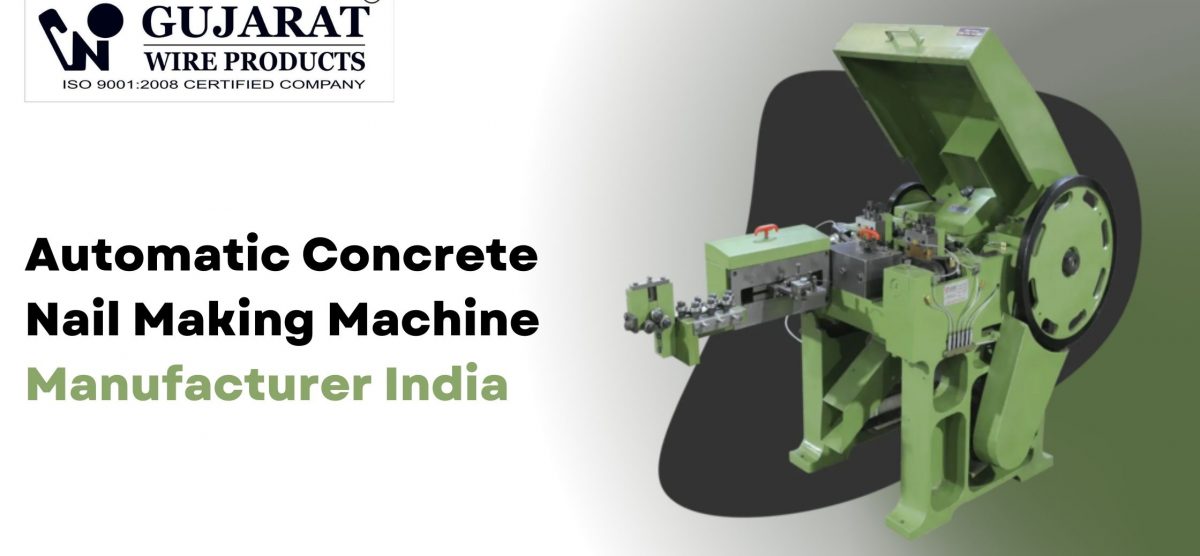
Automatic Concrete Nail Making Machine Manufacturer India
Introduction
Most manufacturers underestimate what separates concrete nails from common wire nails—and that misunderstanding leads to buying the wrong machine entirely. Concrete nails penetrate masonry, brick, and hardened surfaces that destroy standard nails on impact. They require a harder shank, sharper taper point, and tighter dimensional tolerance than wire nails across every size range. Here is the pattern that costs buyers heavily: purchasing general wire nail machines and attempting concrete nail production creates die failures within 20,000 cycles and rejection rates exceeding 18%, because the heading forces and point geometry requirements are fundamentally different. India’s engineering base has developed purpose-built automatic concrete nail machines that handle these demands at production rates previously only available through imported equipment—at 40–60% lower equipment cost. This guide explains how concrete nail machines differ from standard models, what specifications to verify, the full production process, and why Indian-manufactured equipment now sets the benchmark for this product category.
What a Concrete Nail Machine Actually Does
Concrete nail machines form nails from hardened steel wire by feeding, straightening, cutting, heading, and pointing in a continuous automated cycle. The critical difference from wire nail machines is the pointing die geometry—concrete nails require a steeper, more precisely ground point angle to penetrate masonry without bending or shattering on impact.
These machines also apply significantly higher heading force to form the flat, wide head that resists pull-through in formwork and masonry applications. Standard nail machine frames lack the rigidity to absorb these forces at sustained production speeds without developing alignment drift.
Machine Types and Output Capacities
High-Speed Automatic Models
High-speed automatic concrete nail machines produce 200–450 nails per minute depending on nail diameter and length. These machines handle the full size range from 1.2mm to 5.5mm wire diameter and 16mm to 150mm finished nail length. PLC controls manage wire feed, heading pressure, and cycle timing without manual adjustment between batches.
Single vs. Multi-Station Configurations
Single-station machines suit operations producing one nail specification at a time in large batches. Multi-station configurations allow parallel production of different nail sizes, reducing changeover frequency for manufacturers serving diverse construction supply customers. The output advantage of multi-station setups only justifies cost when daily size-switching exceeds four changeovers.
Key Technical Specifications
Before purchasing, verify these specifications against your actual production requirements:
- Wire diameter range: 1.2mm–5.5mm covers standard concrete nail sizes; confirm machine handles your target gauge without adapter dies
- Nail length range: 16mm–150mm covers most construction applications
- Production speed: 200–450 nails/minute depending on size
- Motor power: 2.2–5.5kW depending on model and capacity
- Heading force rating: Must specify hardened steel capability, not just mild steel
- Point die material: Tungsten carbide point dies last 3× longer than standard steel on hardened wire
- Safety guards and emergency stops: Enclosed frame with three-point emergency access
The Production Process
- Wire coil loads onto decoiler pay-off stand; tension set for consistent feed
- Wire enters straightening unit with multi-roller alignment
- Feed mechanism advances wire to precise cut length
- Cutting blade shears wire to nail length while point die forms tapered tip
- Heading punch compresses wire end to form flat nail head under high pressure
- Ejector releases finished nail into collection channel
- Optional barrel polishing removes burrs and improves surface finish
The entire sequence from wire to finished nail takes under 0.15 seconds per cycle at standard production speeds.
Applications Driving Demand
Concrete nails serve construction applications that wire nails physically cannot handle:
- Masonry wall assembly and block laying
- Concrete formwork fastening
- Steel frame attachment to concrete slabs
- Roofing batten and sheathing fixing to masonry
- Civil infrastructure and precast component assembly
India’s infrastructure expansion—covering road, metro, housing, and commercial construction—creates sustained demand for concrete nails that outpaces common wire nail growth. Manufacturers who add concrete nail capability alongside wire nail production capture higher per-kilogram margins because concrete nails sell at 35–50% premium over equivalent weight in common nails.
Why Indian Manufacturers Lead This Category
Indian concrete nail machine manufacturers deliver equipment built for local operating conditions that imported alternatives struggle with:
- Voltage fluctuation tolerance built into motor and control specifications
- Service availability within 48–72 hours in most manufacturing regions
- Spare dies, cutters, and drive components stocked domestically
- Machines factory-tested on Indian wire rod grades before dispatch
- Customization for umbrella head, roofing, and specialty concrete nail profiles
The uncomfortable reality for buyers considering imported machines: lead times of 16–24 weeks, customs duties of 18–28%, and overseas service dependencies eliminate the cost advantage within the first major breakdown. Indian-built machines at comparable specification recover total investment 6–8 months faster through local support infrastructure alone.
FAQs
What nail sizes do automatic concrete nail machines produce?
Standard machines handle wire diameters from 1.2mm to 5.5mm and nail lengths from 16mm to 150mm. Custom configurations extend this range for specialty applications. Always confirm the machine’s heading force rating covers the full diameter range—some machines rated for 5.5mm diameter lose cycle speed by 40% at maximum gauge.
What power supply does a typical machine require?
Most automatic concrete nail machines draw 2.2–5.5kW depending on model capacity. Three-phase 415V supply is standard for Indian installations. Frequency converters are available as add-ons and reduce energy consumption by 20–25% during partial-load production runs.
How long do dies and cutters last on hardened wire?
Tungsten carbide point dies process 400,000–600,000 cycles before replacement on hardened steel wire. Heading dies last 300,000–500,000 cycles depending on heading force and wire hardness consistency. Tracking die cycles per batch prevents unexpected failures that damage adjacent tooling.
Can these machines produce other nail types?
Yes, with die changes. Roofing nails, umbrella head nails, and standard wire nails share the same machine platform with appropriate tooling swaps. Changeover between nail types takes 20–40 minutes depending on how many die components require replacement.
Conclusion
Concrete nail production requires machines built specifically for hardened steel wire and the heading forces masonry applications demand. Buying purpose-built equipment from Indian manufacturers who understand local operating conditions eliminates the service gaps and compatibility issues that erode returns on imported alternatives.
Gujarat Wire Products manufactures automatic concrete nail machines engineered for sustained production of hardened fasteners across the full size range construction and infrastructure applications require. Our machines deliver tungsten carbide tooling, PLC-controlled precision, and the enclosed frame rigidity that keeps production running through 16-hour shifts in India’s manufacturing environments. Ready to add concrete nail capability to your operation? Visit gujaratwireproducts.com or contact our engineering team for model recommendations, production capacity analysis, and a complete tooling specification based on your nail sizes and daily volume targets.