Blog
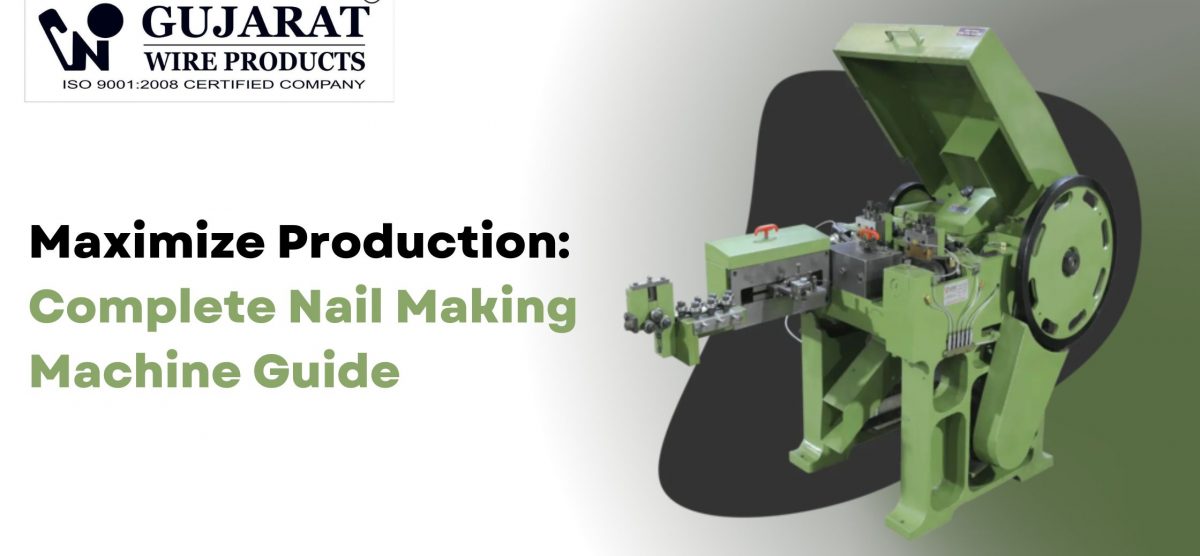
Maximize Production: Complete Nail Making Machine Guide
Introduction
Most nail manufacturers blame machine speed when output falls short. They chase higher RPM ratings without asking why actual throughput rarely matches nameplate capacity. A machine rated for 500 nails per minute might deliver 350 nails per minute in practice because wire quality varies, dies wear unevenly, or operators skip alignment checks between batches. The global wire nail market reached USD 8.5 billion in 2024 and expands at 4.2% annually, driven by construction demand across Asia and Africa. But market growth only benefits manufacturers who sustain high uptime and minimize defect rates. Production capacity isn’t determined by peak speed during demos—it’s calculated from sustained output across full shifts, accounting for changeovers, maintenance stops, and material handling delays. This guide examines the factors controlling real-world throughput: wire preparation, tooling strategy, maintenance rhythm, and operator discipline. The goal is to help buyers select machines matching their nail mix and output targets, then maximize what those machines actually deliver day after day.
Understanding Machine Types
Automation Levels
Semi-automatic machines require manual wire loading and nail collection. Operators handle changeovers and quality checks continuously. Automatic systems integrate wire feeding, cutting, forming, and collection with minimal manual intervention. Fully automatic lines add polishing, counting, and packing—one operator manages multiple machines simultaneously.
Production volumes determine which automation level makes economic sense. Semi-automatic suits job shops producing varied nail types in small batches. Fully automatic lines justify their premium in operations producing 5+ tons daily of standardized sizes.
Speed Classifications
Standard machines produce 200-300 nails per minute. High-speed systems reach 400-600 nails per minute but demand better wire quality and more frequent die maintenance. The speed premium pays back only when wire consistency supports sustained operation at rated capacity.
Raw Material Impact
Wire Quality Determines Output
Surface rust, diameter variation, and hardness inconsistency reduce effective machine speed by 15-30%. Wire straightening becomes difficult when coils arrive with tight bends or kinks. Cutting accuracy suffers when diameter varies beyond ±0.1mm tolerance.
Buy wire from suppliers maintaining documented quality controls. Test incoming coils for diameter consistency before loading production runs. A slightly higher wire price eliminates downstream problems that cost far more in machine downtime and defect scrap.
The Manufacturing Process
Core Production Steps
- Wire feeding and straightening: Automatic uncoilers maintain consistent tension. Straightening rollers remove coil set and surface contaminants.
- Length control and cutting: Grip mechanisms pull precise wire length. Cutters shear to specification within ±0.5mm tolerance.
- Head forming: Heading dies and hammers strike the wire end, creating nail heads in milliseconds. Die alignment determines whether heads form concentrically.
- Point forming: Pointing dies compress and shape the opposite end. Asymmetric tips indicate die wear requiring immediate attention.
- Polishing and finishing: Rotating drums with sawdust or leather remove burrs and surface oils. Duration affects final appearance and rust resistance.
Maximizing Real Throughput
Tooling Strategy
Dies wear faster than most operators expect. Track cuts per die to establish replacement schedules before quality degrades. Maintain spare die sets for each nail size in production rotation. Sharpening dies weekly extends life and maintains cut quality.
Here’s what manufacturers miss: die condition affects every downstream operation. Dull cutters create burrs that jam the heading mechanism. Worn heading dies produce off-center heads that fail quality checks. The cost of premature die replacement is far less than the scrap and downtime from running worn tooling too long.
Changeover Discipline
Switching between nail sizes takes 15-30 minutes when settings are documented and tooling is organized. Fast changeovers require standardized procedures: written setup sheets for each size, pre-staged dies and cutters, calibrated measurement tools at the machine.
Batch similar nail sizes together to minimize changeover frequency. Producing 1-inch and 1.5-inch nails consecutively requires only length adjustment. Switching between 1-inch and 3-inch nails demands complete die changes and feed recalibration.
Lubrication and Cooling
Insufficient lubrication causes friction heat that accelerates die wear and creates dimensional variance as components expand. Check lubricant levels every shift and clean delivery nozzles weekly. Cooling systems prevent thermal expansion errors—verify water flow to die cooling circuits daily.
Maintenance Fundamentals
Preventive Schedule
Daily tasks include:
- Visual inspection for loose fasteners and abnormal noise
- Lubrication point checks on feed mechanisms and cams
- Quick measurement of sample nails for dimensional drift
Weekly requirements:
- Deep cleaning of wire path and cutting area
- Die sharpness inspection and replacement as needed
- Belt tension and bearing condition assessment
Monthly procedures:
- Complete alignment verification of cutting and forming stations
- Control system calibration for PLC-equipped machines
- Spare parts inventory review and replenishment
Common Failure Modes
Bent nails indicate misaligned cutting or feeding mechanisms. Off-center heads signal worn heading dies or improper wire grip. Length variation beyond ±0.5mm suggests cutter dullness or inconsistent wire feed. Addressing these symptoms immediately prevents cascade failures that damage expensive components.
Selection Criteria
Matching Capacity to Demand
Calculate daily nail requirements across all sizes and styles. Account for realistic uptime percentages—most operations achieve 75-85% utilization including changeovers, breaks, and minor adjustments. A machine rated for 400 nails/minute produces roughly 240,000-288,000 nails per eight-hour shift at 80% uptime.
Critical Specifications
Verify these factors before purchase:
- Wire diameter range matching your nail size mix
- Changeover simplicity for multi-size production
- Die availability and replacement cost
- Control system clarity for operator training
- Service response time and spare parts logistics
Visit operating installations similar to your planned setup. Request sample nails produced across the full size range you intend to manufacture. Test those samples for dimensional consistency and surface quality.
FAQs
Q: What’s the realistic output difference between 300 and 500 nails/minute machines?
A: Actual throughput depends more on uptime than peak speed. A 300 nails/min machine running at 85% uptime outproduces a 500 nails/min machine at 60% uptime. Focus on sustained performance rather than nameplate ratings.
Q: How much does wire quality affect production capacity?
A: Poor wire quality reduces effective speed by 15-30% through increased jams, defects, and die wear. Investing in consistent wire typically recovers its cost within the first production month through higher uptime and lower defect rates.
Q: When should I replace dies versus sharpening them?
A: Sharpen dies when edge inspection shows minor dulling but the cutting geometry remains intact. Replace dies when cracks appear, when sharpening no longer restores performance, or when dimensional accuracy degrades beyond recovery.
Q: What operator training determines production success?
A: Teach recognition of early warning signs: unusual noise, vibration changes, temperature increase, dimensional drift in sample checks. Operators who catch problems early prevent major failures and sustain higher uptime percentages.
Q: How do I calculate actual cost per thousand nails?
A: Include wire cost, electricity, labor, die replacement, maintenance supplies, and defect scrap. Track these expenses weekly to identify cost drivers. Most manufacturers underestimate die costs and overestimate labor efficiency in their projections.
Conclusion
Production maximization comes from matching machine specifications to nail requirements, maintaining tooling discipline, and training operators to recognize early problem indicators. Request a detailed consultation to evaluate machine options based on your specific nail mix and daily volume targets.
Gujarat Wire Products has manufactured nail making machine equipment and wire processing machinery since 1975, serving operations across India, Africa, Europe, and Asia. Our ISO 9001:2008 certified machines integrate proven mechanical designs with modern control systems. We provide complete technical support including installation supervision, operator training programs, and preventive maintenance planning that keeps production lines running at target capacity.
Schedule a factory demonstration—visit gujaratwireproducts.com or contact our engineering team to discuss your nail production requirements. We’ll help you calculate realistic throughput expectations and match machine specifications to your actual manufacturing conditions.