Blog
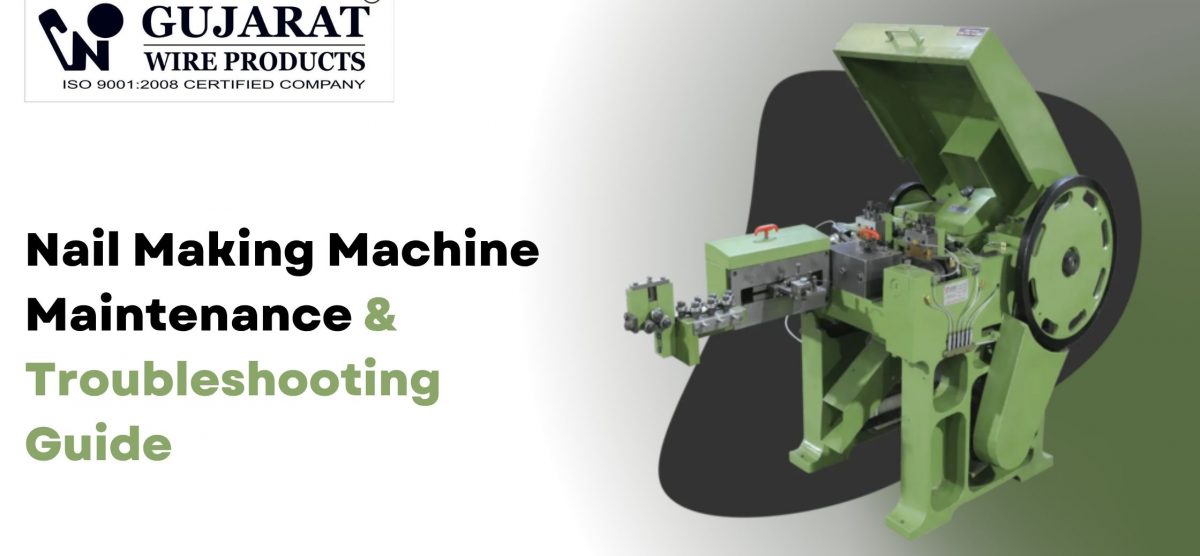
Nail Making Machine Maintenance & Troubleshooting Guide
Most nail machine breakdowns are not random. They follow a pattern: lubrication gets skipped during a busy shift, cutting knives run two days past their sharpening interval, a loose set screw vibrates unnoticed for a week, and then the nail making machine stops mid-production with a jammed die block or a cracked heading punch. The breakdown looks sudden. The cause was accumulating for days. Reactive maintenance—fixing things after they fail—costs three to five times more per incident than a structured preventive schedule, when you account for lost output, emergency spare parts, and the secondary damage a failed component causes to adjacent parts.
This guide lays out a concrete maintenance framework: daily, weekly, and monthly tasks with specific actions, followed by a systematic troubleshooting reference for the problems that show up most often in nail production—feeding failures, heading defects, length variation, mechanical noise, and electrical faults. Work through this schedule consistently and your nail machine runs predictably instead of unpredictably.
Daily maintenance routine
Daily maintenance takes under fifteen minutes per shift. Skipping it regularly is the single fastest way to compress a machine’s effective service life.
Cleaning and inspection
- Clear metal swarf, wire residue, and nail chips from the die block, feed rollers, and cutter zone after every shift
- Wipe down the machine exterior and check for fresh oil leaks or unusual residue around bearings
- Check wire straightening rollers for metal buildup—accumulated wire deposits change the effective roller gap and cause nail length variation
Lubrication
- Top up the central lubrication system with lithium-based grease before the shift starts
- Manually grease cam followers, linkages, and exposed bearing surfaces per the machine’s lubrication map
- Verify gearbox oil level and pump operation—a dry gearbox can destroy a main shaft in under an hour of dry running
Weekly maintenance tasks
Weekly checks catch wear before it becomes damage. Spend 45–60 minutes per week on these:
- Cutting knives: Inspect edge condition under good lighting; sharpen when you see any flatting or rounding at the tip—don’t wait for burrs on nails to appear
- Heading dies: Check face geometry and surface condition; irregular head shapes signal die wear, not machine misalignment
- Alignment: Verify feed roller gap (set at 0.1–0.2mm above wire diameter), cutter position, and die gap
- Fasteners: Torque-check all mounting bolts, set screws, and clamp hardware—vibration loosens fasteners faster than most operators expect
- Electrical system: Inspect sensor connections, limit switch operation, and wiring runs for abrasion or heat damage
Monthly deep service
Monthly service addresses wear that daily and weekly checks don’t reach:
- Sharpen or replace cutting knives and heading dies as a matched set—mixing worn and new tooling creates uneven loading on the forming mechanism
- Disassemble and re-grease bearing housings with fresh lithium grease; check bearing races for pitting or roughness
- Inspect drive belts for cracking, glazing, or stretch; replace before they snap during production
- Recalibrate length adjustment, speed settings, and sensor trigger points—drift in these parameters accumulates slowly and shows up as unexplained reject rates
Troubleshooting common problems
Feeding and wire issues
Wire feed stops or clogs repeatedly
Cause: dirty feed rollers, incoming wire diameter variation beyond ±0.05mm, or rust/scale on wire surface.
Fix: clean rollers thoroughly, measure ten samples across the coil with a micrometer, reject wire that falls outside tolerance.
Wire surface shows scratches or scoring marks
Cause: feed roller gap too tight, worn straightening rollers.
Fix: reset roller gap to target, replace straighteners showing groove wear.
Nail quality problems
Burrs and rough edges on nail points
Cause: dull cutting knives running past their service interval.
Fix: sharpen or replace blades immediately—continuing past this point damages the cutter seat.
Irregular nail lengths across the same batch
Cause: worn or misaligned cutter mechanism, wire coil feeding unevenly.
Fix: realign cutter to spec, check coil winding tension at the feed end.
Nail heads cracking or splitting
Cause: carbon content above 0.12% in the wire, excessive heading pressure.
Fix: verify material certificate for wire batch, reduce heading pressure in 5% increments until cracking stops.
Bent or bowed nail shanks
Cause: uneven wire tension from the drawing process, contaminated die surfaces.
Fix: check drawing speed consistency, clean dies with compressed air and solvent.
Mechanical and electrical faults
Excessive vibration during operation
Cause: loose fasteners, worn bearings, unbalanced cam assembly.
Fix: full fastener torque check, bearing replacement if roughness is present.
Machine overheating
Cause: blocked cooling vents, lubrication failure, sustained overload.
Fix: clean cooling path, check oil levels, reduce production speed temporarily.
Electrical tripping or control faults
Cause: motor overload from mechanical binding, loose wiring at terminals.
Fix: check for mechanical resistance before resetting breakers—electrical symptoms frequently point to mechanical causes.
Spare parts management
A pattern that runs across nail production operations globally: factories that stock critical spares on-site spend 40% less on unplanned downtime than those who order parts reactively. The spare parts that belong in your cabinet at all times:
- Cutting knives: minimum 4 spare blades per machine
- Heading dies: minimum 2 complete sets
- Drive belts: one set per machine
- Return springs and cam followers
- Position sensors and limit switches
- Feed roller bearings
Order spare parts by batch at commissioning. Parts ordered reactively during breakdown arrive in days—days when your production line is idle.
Operator training and safe operation
Operators who understand what they’re watching catch problems before they escalate. Train your team on:
- Pre-start checklist: Wire loaded correctly, lubrication confirmed, guards in place, no loose material near the forming zone
- During-run monitoring: Nail head consistency, point quality, any change in machine sound or vibration
- Shutdown procedure: Correct wire-out sequence, cleaning before next shift, logging any anomalies observed
FAQs
How often should cutting knives be sharpened?
Inspect every 8–12 operating hours. The visual trigger is a flattened or rounded edge visible under direct light—don’t wait for nail defects to confirm it. On high-speed machines running at 300+ nails/min, knife condition degrades faster; check at 8 hours initially and adjust the interval based on observed wear rate.
What causes heading dies to fail prematurely?
Contaminated wire (scale, rust, hard inclusions) is the primary cause, followed by incorrect heading pressure and misalignment between punch and die. Most die failures attributed to “poor quality dies” actually trace to wire surface problems or a punch that’s out of square by 0.5–1mm—enough to create edge loading that cracks the die face.
Can I sharpen cutting knives in-house?
Yes, with a dedicated tool grinder and a trained operator. In-house sharpening is significantly cheaper than sending knives out and eliminates the lead time that forces you to run dull tooling. Match the sharpening angle precisely to the original knife geometry—even 2° of variation changes the cutting action and affects nail point quality.
How do I know when a bearing needs replacement rather than regreasing?
A bearing that needs regreasing produces a dry, high-frequency whine that clears after lubrication. A bearing that needs replacement produces roughness or rumbling that persists after greasing, or shows pitting and scoring when inspected. Replace at the first sign of roughness—a failed bearing during production often takes the shaft housing with it.
Maintain the schedule, protect the investment
Nail making machine maintenance is straightforward when you treat it as a system—daily lubrication and cleaning, weekly tool inspection, monthly deep service, and a stocked spare parts cabinet. The machines that run for ten years without major overhauls are not better machines. They’re better-maintained machines running on correct wire.
Gujarat Wire Products manufactures nail making machines built for continuous production, and we back every machine with maintenance kits, on-site commissioning, and same-day spare parts dispatch from our Rajkot facility. Our technical team supports your operators with structured training and remote diagnostics so your line keeps running between service visits.
Ready to set up a maintenance program for your nail production line? Visit gujaratwireproducts.com or contact our service team for a maintenance schedule, spare parts kit recommendation, and tooling guidance matched to your machine model and output targets.