Blog
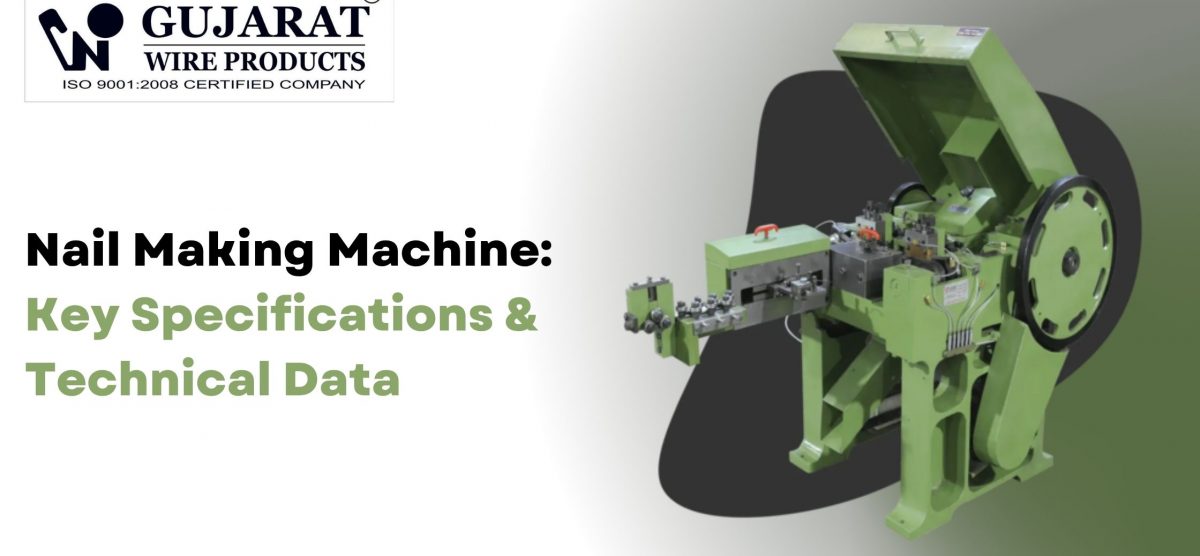
Nail Making Machine: Key Specifications & Technical Data
Introduction
Most nail machine buyers request a quote before understanding a single specification—and that sequencing causes expensive mismatches between equipment capabilities and actual production requirements. The two most common traps: treating rated speed as real output, and treating motor power as a proxy for production capacity. A machine rated at 600 nails per minute running 4mm wire at 100mm length will realistically deliver 350–400 nails per minute under sustained production conditions. Motor power tells you the electrical draw, not the heading force available at your specific wire grade and diameter. These gaps between catalog data and production reality cost manufacturers in scrap, wire breakage, and unplanned downtime from day one. This guide breaks down every core specification category, explains what each parameter actually controls, covers wire material requirements that determine whether a machine runs cleanly or struggles, and gives you the framework to match machine specs to your actual nail portfolio and shift targets.
Machine Model Categories
Nail making machines segment into three production tiers by capacity:
- Entry-level models: 150–250 nails per minute, suited for small workshops producing limited nail sizes in moderate volumes
- Standard production models: 200–300 nails per minute for mid-sized operations with diverse nail portfolios and regular batch changeovers
- High-speed commercial models: 400–800+ nails per minute for continuous large-volume production targeting construction supply and export markets
The tier boundary isn’t just speed—frame rigidity, heading force rating, and lubrication system design all scale with the category. Running high-speed frames at entry-level economics produces premature wear that erases the cost saving within 18 months.
Core Technical Specifications
Wire Diameter and Nail Length Range
Standard machines handle wire diameters from 0.9mm to 6.0mm and nail lengths from 6mm to 150mm, with specific models optimised for sub-ranges within that window. Attempting production at the absolute limits of a model’s range—thinnest wire or longest nail—drops usable output by 25–35% and accelerates die wear significantly.
Production Speed
Rated speed applies at optimal conditions: mid-range wire diameter, mid-range nail length, clean wire, and calibrated tooling. Practical output drops predictably as nail size increases. A machine rated at 500 nails per minute on 2-inch nails at 2.5mm wire typically delivers 280–320 nails per minute on 4-inch nails at 4mm wire. Always request speed data for your specific nail sizes, not just the catalog maximum.
Motor Power and Electrical Specs
Power ratings range from 1.5kW for small workshop models to 10kW for heavy-duty high-speed machines. Standard Indian plant installations require 415V, three-phase, 50Hz supply. Frequency converters reduce energy draw by 20–25% during partial-load runs and protect motors during voltage fluctuation events common across smaller manufacturing regions.
Machine Dimensions and Weight
Shipping weight ranges from 400kg for compact models to over 2,000kg for heavy-duty frames. Confirm gross weight against your floor loading capacity before installation. Footprint dimensions determine whether machines fit single-row or back-to-back plant layouts without creating wire handling bottlenecks.
Heading and Forming Specifications
Heading force and punch stroke determine whether a machine can form the nail type you need—not just the size. Concrete nails and roofing nails require 30–50% higher heading forces than equivalent common wire nails at the same diameter. Die material matters equally: tungsten carbide dies last 400,000–600,000 cycles on hardened wire versus 150,000–200,000 cycles for standard steel dies. Head thickness tolerance should hold within ±0.1–0.25mm across a production run; wider variation indicates cam wear or die misalignment.
Feed and Cut Specifications
Feed mechanisms use crank drives or servo systems to advance wire to the set length before each cutting cycle. Length accuracy depends on feed mechanism precision—crank drives hold ±0.5mm; servo-driven systems achieve ±0.1mm. Point geometry forms simultaneously with the cut; asymmetrical points indicate cutting blade misalignment or wear. Ejection system capacity must match production speed—undersized ejection channels create backlog that jams every 15–20 minutes at full speed.
Control and Automation Features
Production-ready machines include:
- PLC speed control with real-time adjustment during running production
- Automatic fault-stop for wire break, die jam, and overload conditions
- Automatic lubrication systems on high-speed models eliminating manual greasing risk
- Safety interlocks preventing restart until guards are secured and faults are cleared
- Cycle counters for die life tracking—the single most useful data point for maintenance scheduling
Wire Material and Preparation Requirements
Machine performance is inseparable from wire quality. Recommended steel grades for standard wire nails are Q195 or SAE 1008 with tensile strength between 350–450 MPa. Wire diameter tolerance should stay within ±0.05mm to prevent feed inconsistency and heading failures. Surface scale, rust, and lubricant residue cause die contamination and accelerate cutter wear—wire should enter the machine clean and dry. Thick rod stock above 6mm requires pre-drawing to the target nail diameter before forming.
Production Capacity Matching
Scale your machine selection against these three factors simultaneously:
- Nail size output curve: Smaller nails produce faster; build your capacity model around your largest, most common nail—not your smallest
- Line integration capacity: Polishing drums, weighing stations, and packing equipment must match nail machine output or create bottlenecks downstream
- Shift structure: A single high-speed machine running one shift often delivers less daily tonnage than two standard machines running two shifts with proper maintenance intervals
The contrarian insight most buyers miss: adding a second mid-range machine frequently outperforms upgrading to one larger machine in total daily output, because maintenance windows on the second unit eliminate the full-plant stoppage a single-machine operation faces every service cycle.
FAQs
How do you interpret speed specifications for your specific nail size?
Request a speed-versus-nail-size table from the manufacturer, not just the maximum rated figure. Apply a 25–30% reduction to rated speeds to estimate real sustained output. Verify the figure specifically at your most common diameter and length combination before finalising the machine model.
What is the actual power draw during production versus idle?
Machines draw 60–70% of rated power during continuous production and 15–25% during idle running with no load. Frequency converter-equipped machines draw proportionally to load rather than a fixed rate, saving measurable electricity on partial-load shifts.
How long do dies last on standard mild steel wire?
Tungsten carbide dies on Q195 mild steel process 500,000–700,000 cycles before replacement. Hardened wire grades reduce that figure by 30–40%. Tracking die cycles per nail size and wire batch turns die replacement from an emergency into a scheduled cost.
What dimensions and weights should buyers confirm for shipping?
Request gross weight including packaging, crate dimensions, and skid footprint. Confirm these against your transport vehicle capacity, loading dock height, and plant entry clearance before dispatch—most installation delays trace back to dimension mismatches discovered on delivery day.
Conclusion
Nail making machine specifications are the bridge between catalog claims and real production performance. Reading them correctly—wire range, actual speed curves, heading force, die material, and power draw—eliminates the mismatches that cost manufacturers in the first year of operation and every year after.
Gujarat Wire Products publishes honest specifications built around real production conditions, not laboratory maximums. Our machines are rated for your wire grade, your nail sizes, and your shift demands—not theoretical ideals. Ready to match specifications to your actual production requirements? Visit gujaratwireproducts.com and share your nail portfolio and volume targets for a detailed technical specification sheet and model recommendation from our engineering team.