Blog
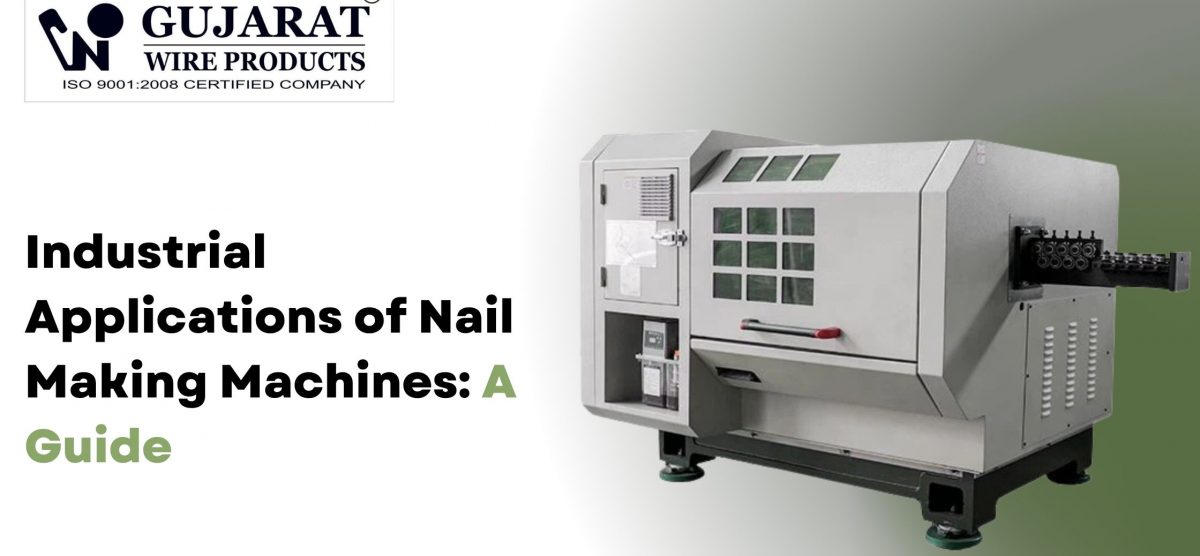
Industrial Applications of Nail Making Machines: A Guide
Introduction
Most nail machine buyers think in one dimension: construction nails for the local market. That single-sector thinking leaves entire revenue streams untapped. Pallet manufacturers need 2–4 inch nails by the tonne. Furniture factories consume brad nails and finishing nails in volumes that dwarf small hardware shops. Agricultural fencing operations across Africa and South Asia represent a growing export category that Indian nail producers underserve. The global nail market crossed USD 8.5 billion in 2024, and construction accounts for only 60% of that demand—meaning roughly USD 3.4 billion flows through packaging, furniture, agriculture, and industrial sectors that most nail producers ignore. Understanding which applications require which nail types, and which machine configurations produce them efficiently, determines whether a nail plant serves one market or five. This guide maps every major industrial application to specific nail specifications, explains the machine requirements for each, and shows how production decisions translate into market access and pricing power.
Construction and Building
Structural and Framing Applications
Common nails (1.5–4 inch, 8–12 SWG) dominate structural framing, floor sheathing, and wall assembly. High-volume construction sites consume nails faster than hardware distribution can supply—a single residential project uses 20,000–30,000 nails across framing, sheathing, and finishing stages.
Concrete formwork requires hardened nails with fluted shanks that drive through timber into concrete without bending. Standard wire nails buckle on impact with dense concrete forms. Producing both nail types from one plant—standard automatic for framing, concrete nail making machine for formwork—captures the full contractor supply chain.
Roofing and Siding
Umbrella head roofing nails distribute load across roofing felt and shingles, preventing pull-through under wind uplift. These nails require modified heading tooling producing large-diameter heads in a single forming strike. Galvanized coating adds corrosion resistance for exterior exposure—meaning the wire input, machine tooling, and finishing process all differ from standard bright wire nails.
Packaging and Crating
Pallet and Box Manufacturing
Wooden pallets consume more nails per unit than almost any other application—a standard 120cm x 100cm pallet uses 40–60 nails. India produces over 200 million wooden pallets annually, with demand accelerating as e-commerce and cold chain logistics expand. Pallet manufacturers buy nails in 25–50 kg bulk packs and prioritize dimensional consistency over surface finish.
Export crates and wooden shipping containers use nails sized to timber thickness—typically 2–3.5 inch, smooth shank for fast driving with pneumatic tools. Suppliers who can deliver consistent lengths in collated coil format command price premiums over those supplying loose nails.
Furniture and Woodworking
Frame and Finish Applications
Furniture factories use three distinct nail types, each requiring different machine tooling:
- Common wire nails (1–2 inch): Timber frame joints in sofas, beds, and cabinet boxes
- Brad nails (18–20 gauge, 0.5–1.5 inch): Trim attachment and decorative molding
- Finish nails (15–16 gauge, 1–2.5 inch): Face-frame assembly where head visibility matters
Splitting dry hardwood during nail driving is a quality rejection trigger for furniture manufacturers. Sharp, well-formed diamond points with consistent geometry prevent splitting. Worn pointing dies are the most common cause of splitting complaints in furniture nail supply.
Agricultural and Fencing
Rural Infrastructure Demand
Fencing for livestock, crop protection, and boundary marking consumes nails at scale across rural India, Africa, and Southeast Asia. A single kilometre of post-and-rail fence uses 800–1,200 nails depending on rail spacing and post count.
Agricultural applications tolerate less precise dimensional control than furniture or construction structural applications—the critical specification is shank strength and point sharpness for driving into hardwood posts. Galvanized nails resist seasonal moisture cycling better than bright wire in outdoor agricultural settings.
Industrial and Manufacturing Uses
Logistics and Skid Construction
Machinery manufacturers build wooden shipping skids for equipment exports using 3–5 inch common nails in high volumes. Industrial packaging for heavy equipment requires nails with adequate shank diameter to resist shear forces during transit. A single export skid for a large machine might use 200–300 nails—multiply that across a manufacturer shipping 50 units monthly and the supply volume becomes significant.
Temporary wooden formwork for metal casting and molding uses nails that must drive cleanly and pull cleanly after use. Smooth shank nails with well-formed heads serve this requirement; ring shank nails create extraction problems that damage formwork.
Export and Specialty Markets
Collated Coil Nail Demand
Pneumatic framing nailers have transformed construction productivity—framing crews using coil nailers work 3–4 times faster than hand-nailing crews on the same tasks. Coil nails (collated in 120–300 nail coils) command 15–25% price premiums over equivalent loose nails because the collation adds value that contractors pay for directly.
Producing collated coil nails requires a standard nail making machine plus a collation attachment—a relatively modest equipment addition that opens a premium market segment. Operations already producing standard wire nails can add coil nail capability without replacing core equipment.
Africa and Emerging Market Exports
Construction activity across Sub-Saharan Africa and South Asia generates sustained nail demand that local manufacturers can’t fully supply. Indian-produced nails compete effectively on price and quality against imports from other markets. Galvanized nails for coastal construction applications and tropical climates represent the fastest-growing export sub-category from Indian nail producers.
Machine Selection by Application
Matching Configuration to Output Requirements
Different applications need different machine setups:
- High-volume construction nails: Standard automatic machines (300–500 nails/min) with bright wire input
- Roofing and umbrella head nails: Modified heading tooling on standard-speed machines; larger die diameter
- Concrete and hardened nails: Dedicated machines with hardened wire handling capability
- Brad and finishing nails: High-speed fine-gauge machines with close-tolerance pointing dies
- Coil nails: Standard nail machine plus pneumatic collation attachment
Running concrete nails on a standard wire nail machine destroys the pointing die within hours. Tooling compatibility defines machine suitability for each application—not motor size or frame weight.
Production Factors by End-Use
Wire Specification and Quality Control
Each application demands different wire specifications:
- Construction nails: Q235 mild steel, 380–500 MPa tensile
- Roofing nails: Galvanized wire with uniform zinc coating for corrosion resistance
- Concrete nails: High-carbon hardened wire, 700–900 MPa
- Furniture nails: Bright drawn Q195 wire for clean surface finish
Quality control tests also shift by application. Construction nail buyers measure shank diameter and head pull-through resistance. Furniture buyers test splitting tendency in dry hardwood. Pallet manufacturers check point sharpness and driving consistency in automated nailers.
FAQs
Can one nail making machine serve both construction and furniture nail markets?
A standard automatic machine handles 1–4 inch construction nails efficiently. Furniture brad and finishing nails require finer wire gauges (18–20 AWG) and smaller heading tooling that most standard machines don’t accommodate. A plant targeting both markets typically runs two machine configurations rather than forcing one machine across incompatible wire gauges.
What nail type generates the highest margin for a new nail plant?
Collated coil nails for pneumatic nailers command 15–25% price premiums over equivalent loose nails. The market rewards consistent collation quality and dimensional accuracy because incompatible nails jam nailers on job sites—a problem contractors pay to avoid. Entry requires a collation attachment plus standard nail making capability already in place.
How does galvanizing affect machine requirements?
Galvanizing happens post-production through hot-dip or electro-galvanizing processes that are separate from the nail making machine. The nail machine produces bright wire nails; a galvanizing line adds the zinc coating. Operations producing galvanized nails need both capabilities or must outsource the coating process to a specialist.
What wire gauge suits pallet nail production?
Standard pallet nails use 9–11 SWG wire (3.65–3.05mm diameter) for adequate shear strength under load. Thinner gauges save material cost but fail under the dynamic loading pallets experience during forklift handling. Most pallet manufacturers specify minimum shank diameter in their supply contracts.
How do agricultural fencing nails differ from standard construction nails?
Fencing nails prioritize corrosion resistance over dimensional precision—galvanized coating and adequate shank length for timber penetration matter most. Head size is secondary because fencing nails don’t require the same pull-through resistance as structural applications. A standard machine with galvanized wire input satisfies most fencing nail specifications.
Conclusion
A nail making machine that produces only one nail type for one market leaves significant revenue unrealized. Map your nail mix to the sectors above, verify tooling compatibility for each type, and evaluate which specialty markets your wire source and machine configuration can serve. Contact our team today to discuss machine specifications matched to your target applications and production volume.
Gujarat Wire Products has manufactured nail making machines and wire processing equipment since 1975, supplying operations across India, Africa, Europe, and Asia. Our machine range covers standard automatic, high-speed, roofing, concrete, and coil nail configurations—with integrated wire drawing solutions for end-to-end production capability. ISO 9001:2008 certified, with full commissioning support, operator training, and stocked spare parts for uninterrupted production.
Visit gujaratwireproducts.com or call our engineering team to discuss which machine configuration matches your target nail applications, wire input specifications, and daily volume targets