Blog
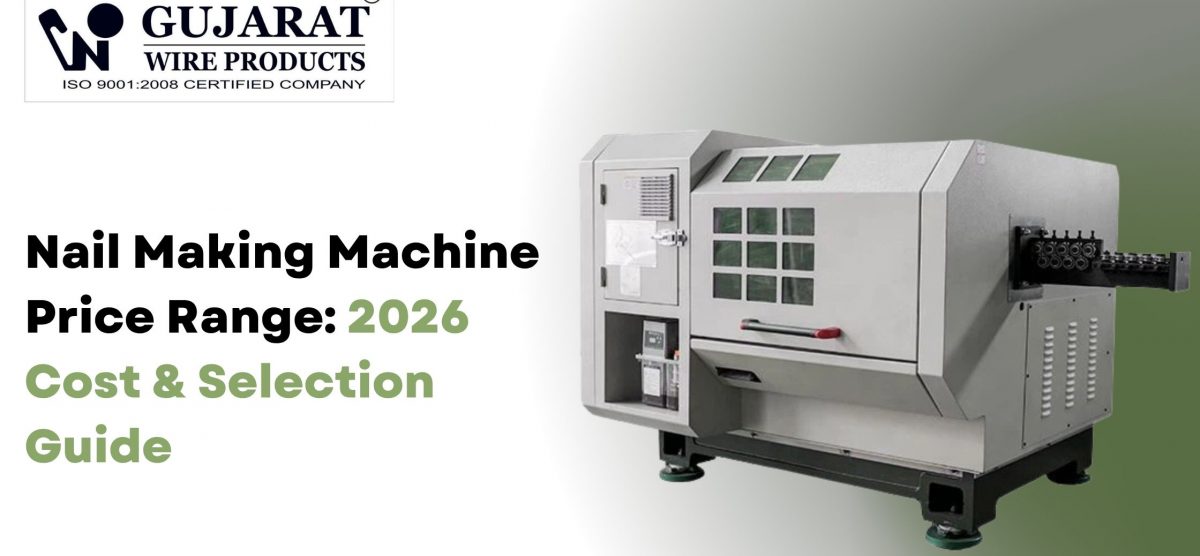
Nail Making Machine Price Range: 2026 Cost & Selection Guide
Most nail making machine buyers focus entirely on the sticker price, then run into a costly surprise: the machine they bought for ₹2.5 lakh needs another ₹1.5–2 lakh in wire drawing, polishing, and grinding equipment before it produces a single saleable nail. Industry purchasing patterns show that buyers who compare machine prices without accounting for auxiliary equipment and operating costs consistently underestimate total setup investment by 40–60%. This guide cuts through that confusion. You’ll find actual 2026 price ranges by machine type, the technical factors that justify higher prices, a clear breakdown of total cost of ownership, and a selection checklist that matches machine specifications to your actual production needs—not the most impressive brochure number. Whether you’re setting up a startup nail unit or upgrading an existing line, this framework gives you the numbers and logic to make a well-grounded purchase decision.
2026 Price Ranges by Machine Type
Nail making machine prices in India span a wide range in 2026. Each band reflects a specific capacity and automation level.
Entry-Level and Semi-Automatic Machines
- Price range: ₹1.2–3.5 lakh
- Motor power: 2–3 HP
- Output: 100–300 nails per minute
- Best fit: Startup operations, small workshops, and low-volume production where simplicity and low maintenance cost matter more than throughput
Mid-Range Fully Automatic Machines
- Price range: ₹3.5–7 lakh
- Motor power: 3–5 HP
- Output: 300–500 nails per minute
- Best fit: Medium workshop production with consistent nail mix and daily tonnage targets that justify automation
High-Speed Automatic Machines
- Price range: ₹7–15 lakh
- Motor power: 5–10 HP
- Output: 500–800 nails per minute
- Best fit: Factory-scale bulk production where labor efficiency and continuous high-volume runs drive the investment case
Premium Rotary and Line-Integrated Systems
- Price range: ₹15 lakh and above
- Output: 800+ nails per minute
- Best fit: Large industrial operations running integrated lines with wire drawing, forming, polishing, and collation coordinated across a single production floor
What Drives Price Differences
Price differences across bands reflect real engineering differences, not arbitrary margin decisions.
Production Speed and Structural Demands
Higher cycle rates require better frame balancing, stronger alloy steel components, and heavier-duty bearings to absorb continuous vibration. A machine running at 700 nails per minute places fundamentally different mechanical loads on its frame than one running at 200.
Automation and Control Systems
Entry-level machines use mechanical cam systems. Mid-range and above shift to PLC controls, servo drives, and optical sensor systems for wire-break detection and automatic shutdown. This is what prevents a jam at high speed from destroying a full set of tooling in seconds.
Tooling Quality
Die and cutter materials vary significantly across price bands. Lower-cost machines use standard steel tooling that wears faster under sustained production. Higher-priced machines use hardened alloy dies that last 3–5 times longer under equivalent conditions—often making the per-nail tooling cost lower on the more expensive machine.
Total Cost of Ownership
The machine price is the smallest part of what you’ll spend in year one.
Auxiliary Equipment You Cannot Skip
- Wire drawing machine: ₹1–3 lakh depending on die count and speed
- Nail polishing drum: ₹50,000–1.5 lakh
- Cutter and die grinder: ₹30,000–80,000
- Total auxiliary investment: Typically 40–60% of base machine price
Ongoing Operating Costs
Power consumption runs 3–15 HP depending on machine scale. At sustained production, tooling replacement cycles run every 2–4 weeks. Spare parts lead time determines how much downtime you absorb when something wears out. A machine with a 3-week spare parts wait costs far more in lost production than the premium you’d pay for better local support.
Scrap and Downtime Cost
Lower-quality machines produce 20–35% more scrap from length variation, bent nails, and misformed heads. Over a full production year, that scrap differential—in wire and labor cost—consistently exceeds the purchase price gap between a budget machine and a quality mid-range model.
Selection Checklist
Follow this order. Skipping steps produces the mismatches that generate buyer regret.
Step 1: Define Your Daily Tonnage Target
Calculate daily wire consumption at your target nail output. This single figure determines which price band is appropriate. Buying a high-speed machine for a low-tonnage operation ties up capital without proportional return.
Step 2: Verify Build and Reliability Specifications
Ask specifically about:
- Frame material and rigidity rating
- Bearing grade and load capacity
- Tooling material and replacement interval at your wire hardness
- Sensor and shutdown system specs
Step 3: Confirm Local Support and Spares Access
Request the manufacturer’s service response time in writing. Ask for spare parts pricing on the 10 most commonly replaced items. Manufacturers who can’t provide this data don’t stock those parts locally.
Step 4: Validate With Real Production Data
Ask for a reference site running your wire diameter and nail specification. Visit it. An on-site visit to a live production line reveals more about real-world machine performance than any specification sheet.
FAQs
Why do two machines with the same nails-per-minute rating carry very different prices?
Component quality explains most of the gap. Frame rigidity, bearing grade, alloy steel tooling, and PLC control systems add cost. Machines with identical rated speeds but cheaper components wear faster, produce more scrap, and need replacement sooner. The rated speed figure alone tells you nothing about production consistency or lifespan.
Is it worth buying a high-speed machine for a new setup?
Only if your wire drawing and polishing capacity can match it. A high-speed nail machine fed by undersized drawing equipment runs at effective standard-machine speeds while costing high-speed-machine prices. Start with matched line capacity; upgrade speed after your bottleneck analysis confirms the nail machine is actually the constraint.
How much should I budget for the first year of operations beyond the machine?
Plan for auxiliary equipment (40–60% of machine cost), tooling replacement every 2–4 weeks, power costs, maintenance labor, and a spare parts buffer for the first six months. Buyers who budget only for the machine price typically need a second round of unplanned investment within 90 days.
What’s the most common reason nail machine buyers regret their purchase?
Weak after-sales support, not machine quality. Operators who can’t get a service technician on-site within 48 hours lose days of production on problems that a knowledgeable engineer can fix in two hours. Prioritize proven local support over minor price differences.
Conclusion
The right nail making machine isn’t the cheapest one or the fastest one—it’s the one whose capacity, build quality, and support ecosystem match your actual production scale and operating context. Use the price bands and checklist in this guide to evaluate options side by side on total cost, not sticker price. Contact us today to get a line-level cost analysis specific to your wire source, nail mix, and daily tonnage target.
Gujarat Wire Products supplies nail making machines across the full capacity range—from entry-level semi-automatic units to high-speed fully automatic lines—built for Indian power conditions, wire specifications, and operating environments. We conduct free production assessments covering your current setup, target output, and auxiliary equipment needs before recommending any machine. Our local manufacturing means same-day spare parts access, on-site service within 24–48 hours, and commissioning support that gets your line running to specification from day one. Visit
or call us directly to schedule a production assessment and receive a fully costed recommendation matched to your actual nail manufacturing needs.