Blog
Wire Nail Making Machine Manufacturers – A Guide
Introduction
Buying a wire nail making machine from the wrong supplier costs far more than the price difference between quotes. Equipment commissioned without proper training underperforms for months. Machines built with substandard castings develop alignment problems within two years. Spare parts sourced from distant suppliers arrive weeks after breakdowns idle entire production lines. India’s wire nail machine manufacturing sector clusters heavily in Rajkot, Gujarat—a hub where decades of precision engineering and dense tooling supply chains produce equipment that exports to Africa, Europe, and Asia. Yet within this cluster, capability gaps between suppliers are wider than most buyers realize. A directory listing or trade show booth reveals nothing about service response times, spares stock depth, or whether a manufacturer has ever commissioned a machine in a plant similar to yours. This guide defines the evaluation criteria that separate capable manufacturers from risky ones, explains what product and support offerings actually look like across supplier categories, and provides a five-step shortlisting process for making the right decision.
Types
1. GN1 Wire Nail Making Machine
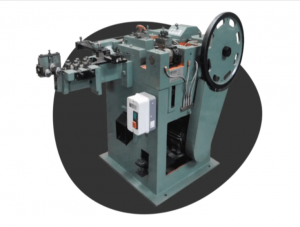
Technical Specifications
| Wire Diameter S.W.G.(mm) | 20-15 / (0.9-1.83) |
|---|---|
| Nail Length Inch (mm) | 1/4 -1.5 / (6 – 38) |
| Max.Nail/min | 500 |
| Power Required hp/kw | 1.5 / 1.11 |
| Approx. nett Weight kgs. | 460 |
| Approx. gross Weight kgs. | 625 |
| Case Size(mm) | 1185 x 1155 x 1125 |
| Approx.Floor Area(mm) | 1100 x 755 |
2. GN2 Wire Nail Making Machine
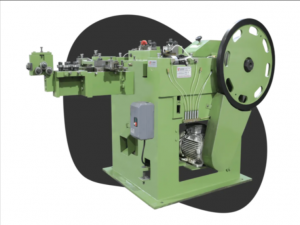
Technical Specifications
| Wire Diameter S.W.G.(mm) | 14-12 / (2-2.9) |
|---|---|
| Nail Length Inch (mm) | 1/2-2.5 / (12-65) |
| Max.Nail/min | 400 |
| Power Required hp/kw | 2 / 1.49 |
| Approx. nett Weight kgs. | 765 |
| Approx. gross Weight kgs. | 915 |
| Case Size(mm) | 1205 x 1125 x 1130 |
| Approx.Floor Area(mm) | 1375 x 950 |
3. GN3 Wire Nail Making Machine
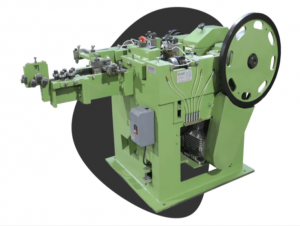
Technical Specifications
| Wire Diameter S.W.G.(mm) | 14-8/ (2.6-4.0) |
|---|---|
| Nail Length Inch (mm) | 1-3.5 / (25-85) |
| Max.Nail/min | 350 |
| Power Required hp/kw | 3 / 2.235 |
| Approx. nett Weight kgs. | 960 |
| Approx. gross Weight kgs. | 1140 |
| Case Size(mm) | 1315 x 1135 x 1145 |
| Approx.Floor Area(mm) | 1600 x 1020 |
4. GN4 Wire Nail Making Machine
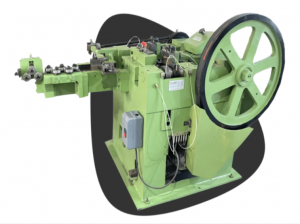
Technical Specifications
| Wire Diameter S.W.G.(mm) | 10-7/ (2.64-4.8) |
|---|---|
| Nail Length Inch (mm) | 1-5 / (25-125) |
| Max.Nail/min | 250 |
| Power Required hp/kw | 5 / 3.72 |
| Approx. nett Weight kgs. | 1350 |
| Approx. gross Weight kgs. | 1500 |
| Case Size(mm) | 1315 x 1140 x 1155 |
| Approx.Floor Area(mm) | 1610 x 1030 |
5. GN6 Wire Nail Making Machine
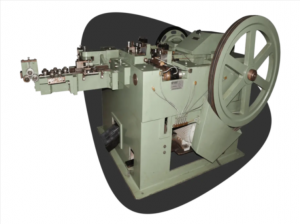
Technical Specifications
| Wire Diameter S.W.G.(mm) | 8-4/ (4.0-6.0) |
|---|---|
| Nail Length Inch (mm) | 1.50”- 6” / (38 -150) |
| Max.Nail/min | 150 |
| Power Required hp/kw | 10 / 7.45 |
| Approx. nett Weight kgs. | 2500 |
| Approx. gross Weight kgs. | 2750 |
| Case Size(mm) | 2450 x 1500 x 1900 |
| Approx.Floor Area(mm) | 1350 x 1270 |
Market Overview
India’s Manufacturing Position
India produces wire nail making machines across a wide capability range—from basic mechanical crank machines to high-speed PLC-controlled systems handling 500+ nails per minute. Rajkot leads production volume, supported by an ecosystem of casting foundries, precision machine shops, and tooling vendors that reduces lead times and component costs.
Export demand from Africa, South Asia, and the Middle East continues to grow as buyers in these markets recognize that Indian-made machines match technical specifications of European equipment at significantly lower landed cost. Indian manufacturers with export experience understand certification requirements, documentation standards, and installation conditions in remote markets.
Machine Types Available
Full-Line Capability Indicators
Leading manufacturers supply complete nail production lines, not just standalone machines. The product range signals capability depth:
- Standard automatic wire nail machines (1–6 inch nail range)
- High-speed enclosed machines (400–600 nails/min, low-noise design)
- Roofing and umbrella head nail machines
- Concrete and hardened nail production systems
- Panel pin, shoe tack, and spiral nail machines
- Coil nail collation systems for pneumatic tool supply
- Wire drawing machines, polishing drums, and cutter grinders
Suppliers offering only one or two machine types often lack the engineering depth to handle customization requests or troubleshoot complex production problems. A manufacturer building both wire drawing and nail making equipment understands the full production chain—wire diameter tolerance, surface condition, and tensile properties—rather than treating the nail machine as an isolated system.
Evaluation Criteria
Technical and Quality Standards
ISO 9001:2008 certification indicates documented quality systems—material inspection, assembly controls, and pre-dispatch testing protocols. But certification alone doesn’t guarantee performance. Ask to review inspection records from recent machines in production. Verify that the manufacturer uses calibrated measurement equipment and maintains records for critical dimensions like spindle runout and die holder concentricity.
Export Track Record
Manufacturers with active exports to multiple countries have resolved problems that domestic-only suppliers haven’t encountered: voltage variation handling, documentation for customs clearance, multilingual operator manuals, and remote commissioning support when on-site visits aren’t practical. Export experience indicates a higher standard of product documentation and after-sales follow-through.
Service Infrastructure
Three questions that reveal true service capability:
- What’s your average response time for a service call within 300km?
- Which of the top 20 wear parts do you stock for immediate dispatch?
- What does your commissioning process include, and how long does it take?
Manufacturers who answer these questions with specifics have functional service systems. Vague responses signal gaps that become your problem post-purchase.
Supplier Categories
Direct Manufacturers vs Traders
Traders and resellers list machines at lower prices but add no engineering value. When a machine needs commissioning adjustments, a reseller passes you back to the OEM—adding delay and accountability gaps at exactly the moment you need fast resolution. Direct manufacturers own the design, control the spare parts supply, and can modify machine specifications for non-standard applications.
Regional Specialists
Rajkot-based manufacturers benefit from same-city access to casting, machining, and tooling vendors. Lead time from order to delivery typically runs 4–8 weeks for standard models compared to 16–24 weeks for imported equipment. Local availability also means service technicians can reach most Indian installations within 24–48 hours.
Comparing Product and Support Offerings
What Full-Service Suppliers Provide
Suppliers with genuine after-sales infrastructure deliver:
- Installation supervision with calibration sign-off
- Structured operator training covering setup, adjustments, and daily maintenance
- Written maintenance schedules and documented troubleshooting procedures
- Spare parts inventory recommendations matched to your production volume
- Annual maintenance contracts with defined response time commitments
Here’s what most buyers overlook: the quality of operator training determines first-year production efficiency more than machine specifications. Plants with well-trained operators run 80–85% utilization within six months. Plants without structured training rarely exceed 65% in the same period.
Build Quality Indicators
Visit the production facility before committing. Examine:
- Frame casting quality (no visible porosity, consistent finish)
- Machining precision on die holder bores and guide surfaces
- Control panel layout and labeling quality
- Assembly cleanliness and fastener torque consistency
These indicators predict long-term reliability better than specification sheets.
Five-Step Shortlisting Process
- Define your nail mix: Document every nail size, head type, and material you plan to produce, plus daily output targets per size
- Filter by proven installations: Ask each shortlisted manufacturer for reference plants producing your nail types—visit at least two
- Request sample production: Have each machine produce 500 nails across your size range; measure 50 pieces for dimensional compliance
- Evaluate service terms in writing: Get response time commitments, warranty scope, and spare parts pricing documented before purchase
- Compare lifecycle cost: Include energy consumption per ton, estimated annual tooling spend, and service contract cost—not just machine price
2026 Industry Trends
Bundled Production Line Demand
Buyers increasingly request complete turnkey lines—wire drawing, nail making, and polishing from a single supplier—to simplify commissioning accountability and spare parts sourcing. Suppliers who build only nail machines face growing competition from integrated line manufacturers offering lower total installation complexity.
Automation Expectations Rising
PLC controls, VFD drives, and automatic wire break detection have moved from premium options to baseline expectations in new machine purchases. Buyers in export markets demand these features for operator safety compliance and production data logging requirements.
Why Gujarat Suppliers Lead
The Rajkot manufacturing ecosystem compresses supplier lead times, reduces component costs, and concentrates decades of application knowledge in a small geographic area. Buyers sourcing from established Gujarat manufacturers access this infrastructure advantage alongside their machine purchase—meaning faster spares delivery, shorter service response windows, and easier face-to-face technical support than distant alternatives provide.
FAQs
What’s the difference between a machine-only supplier and a turnkey line supplier?
Machine-only suppliers deliver the nail making machine and leave integration to you. Turnkey suppliers design the full production flow—wire drawing, nail making, polishing, and material handling—and commission the complete system. Turnkey arrangements cost more upfront but eliminate interface problems between machines from different sources.
How do I verify a manufacturer’s actual export capability?
Request shipping records or export invoices showing deliveries to multiple countries within the past two years. Ask for contact details of two overseas customers you can call independently. Manufacturers with genuine export activity provide this readily; those without typically offer excuses or redirect to domestic references only.
What warranty terms are standard for Indian-made nail machines?
Reputable manufacturers offer 12-month warranty covering manufacturing defects in the machine frame, drive components, and control systems. Consumables—dies, cutters, and bearings—are typically excluded. Get warranty scope in writing and confirm the claims process before purchase.
Can one supplier handle machines for both wire nail and concrete nail production?
Yes, but verify that the supplier has specific experience with hardened nail production—not just standard wire nails. Concrete nail machines require modified pointing tooling, different die materials, and sometimes heat treatment integration. Ask for reference installations specifically producing concrete nails before proceeding.
How long does commissioning typically take for a complete nail production line?
Plan 5–10 working days for a complete line including wire drawing and nail making. Single machine installations take 2–3 days. Commissioning timelines shorter than these indicate inadequate setup and training that creates problems months after the installation team leaves.
Conclusion
Supplier selection determines your nail plant’s production economics for the next decade. Prioritize manufacturers with documented quality systems, full-line capability, active export track records, and verified service infrastructure. Request a consultation today to match machine specifications with your nail production requirements and daily output targets.
Gujarat Wire Products has manufactured wire nail making machines and wire drawing equipment since 1975, exporting to Africa, Europe, and Asia from our Rajkot facility. Our ISO 9001:2008 certified machines cover the complete production range—standard automatic, high-speed enclosed, and specialty nail systems—with integrated wire drawing and polishing solutions. We provide structured commissioning, operator training, documented maintenance programs, and stocked spare parts that sustain production from day one.
Visit gujaratwireproducts.com or call our engineering team to discuss your nail production requirements, review reference installations, and receive a machine proposal matched to your specific nail mix and volume targets.