Blog
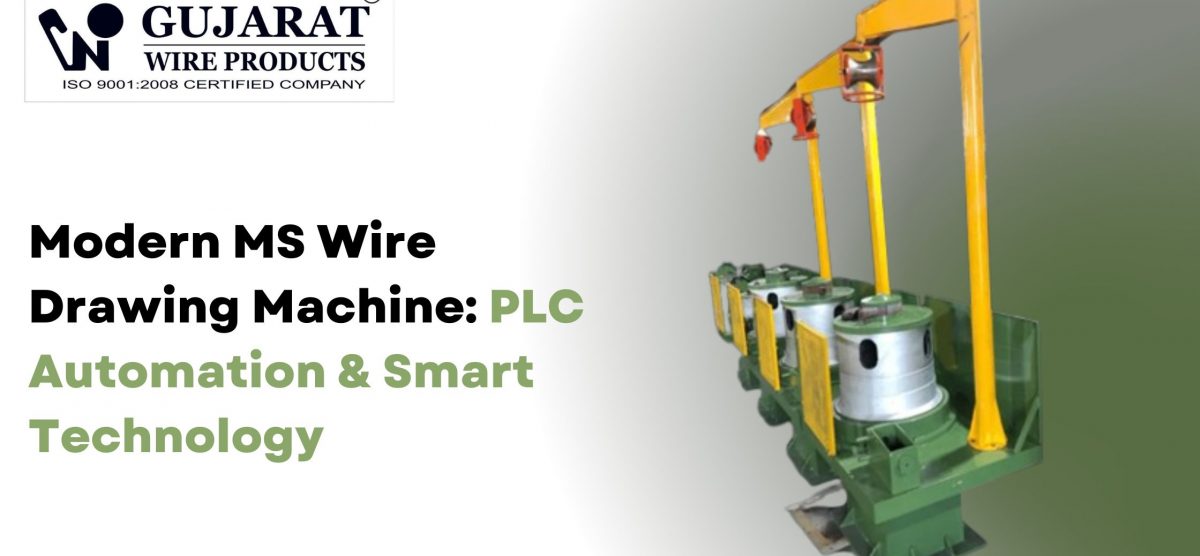
Modern MS Wire Drawing Machine: PLC Automation & Smart Technology
Introduction
Many wire drawing units still depend on manual settings, operator judgment, and reactive maintenance. The result is familiar: diameter drift during long runs, inconsistent tensile properties, unplanned stoppages, and operators adjusting speed and tension by feel. These issues do not appear dramatic in isolation, but over weeks they reduce usable output and make quality hard to guarantee.
Modern MS wire drawing machines address this problem by shifting control from hands to logic. PLC automation and smart sensing replace guesswork with repeatable decisions. Speed, tension, lubrication, and fault response move into a controlled loop. The transformation is not about running faster. It is about running the same way every hour of every shift.
This article explains how PLC automation and smart technology work inside modern MS wire drawing machines. It breaks down machine logic, control layers, real use cases, and buyer evaluation points. The goal is to help decision-makers understand where automation adds value—and where it quietly prevents losses that often go unmeasured.
What is an MS wire drawing machine
An MS wire drawing machine reduces the diameter of mild steel wire by pulling it through a series of dies. Each reduction step is calculated to control strain, surface finish, and tensile strength.
In traditional machines, operators set speeds and tensions manually. Adjustments happen after defects appear.
Modern machines retain the same mechanical principle but add automated control layers that manage the process continuously rather than episodically.
PLC automation in wire drawing machines
What PLC automation means
A PLC is a dedicated industrial controller that executes predefined logic in real time. In wire drawing, it becomes the decision engine.
Instead of fixed mechanical ratios, the PLC adjusts speed, tension, and sequencing based on live inputs.
Core functions handled by PLC
- Capstan speed coordination
- Tension balance between stages
- Start-up and shutdown sequencing
- Interlock-based safety responses
The PLC removes dependence on operator reaction time, which is often the slowest part of the system.
How PLC changes daily operation
Machines no longer wait for visible defects to trigger action. Corrections happen before wire quality drifts out of tolerance.
This is where most productivity gains actually come from.
Smart technology in wire drawing
Sensors and live measurement
Smart machines use sensors to measure tension, speed, temperature, and vibration. These signals feed directly into the PLC.
The system reacts in milliseconds, not minutes.
Feedback loops and adaptive control
When tension rises due to die wear or coil variation, the system compensates automatically. Speed adjustments happen smoothly, without stopping the line.
This closed-loop behavior is what separates automated machines from motor-driven ones.
Data logging and traceability
Smart systems log operating data by batch or shift. Patterns emerge quickly.
Many plants discover that most defects originate during coil changeover, not during steady production.
How PLC and smart systems work together
Closed-loop tension control
Tension sensors feed data to the PLC, which adjusts capstan speeds in real time. This prevents micro-cracks and surface scoring.
The wire experiences fewer stress spikes, especially during acceleration.
Automatic speed synchronization
Multi-stage machines rely on synchronized motion. PLC logic maintains proportional speed across stages, even under load changes.
This reduces uneven wear and extends component life.
Fault detection and response
Instead of running until failure, smart machines detect abnormal conditions early.
- Over-temperature triggers speed reduction
- Excess vibration triggers controlled stop
- Wire break triggers instant shutdown
Damage containment becomes predictable rather than chaotic.
Benefits of automation and smart systems
Consistent diameter accuracy
Automated control holds tolerance over long runs. Variation drops without slowing production.
This is why automated lines often outperform manual lines even at lower speeds.
Reduced operator dependency
Operators supervise instead of constantly adjusting. Skill requirements shift from instinct to process discipline.
This reduces variability between shifts.
Lower scrap and rework
Most scrap originates during transient conditions—start-ups, slowdowns, and coil changes. Automation controls these moments tightly.
The result is fewer borderline batches.
Predictable maintenance patterns
Smart systems reveal wear trends early. Maintenance becomes planned rather than reactive.
This is less visible than speed gains but more valuable over time.
Industrial use cases
Heavy MS wire for construction
Large diameters and long runs benefit from tension stability. PLC control prevents diameter drift during extended shifts.
This reduces downstream rejection in cutting and forming.
Automotive and engineered wire
These applications demand repeatability. Smart monitoring ensures surface and tensile properties stay within narrow bands.
Automation reduces dependency on manual inspection.
Multi-pass production lines
As pass count increases, manual coordination fails. PLC synchronization keeps multi-stage lines stable.
This is where automation becomes non-negotiable.
Key features buyers should evaluate
HMI clarity and usability
A clear interface reduces response time. Overloaded screens slow down fault resolution.
Simple visuals often outperform complex dashboards.
Sensor placement and quality
Sensor accuracy matters more than quantity. Poor placement creates false confidence.
Buyers should ask what each sensor actually controls.
Data accessibility
Logged data should be usable, not just stored. Trend visibility helps improve processes beyond the machine.
Safety logic and interlocks
Automation should fail safely. Controlled stops protect both wire quality and mechanical components.
Manual versus PLC automated machines
Manual machines offer flexibility but rely on constant attention. Automated machines trade some flexibility for consistency.
In real plants, automated machines often run slower than rated speed but produce more usable wire per shift. This feels counterintuitive but shows up repeatedly in production logs.
Another uncomfortable insight is that many manual lines hide losses in “acceptable variation.” Automation makes those losses visible—and correctable.
How to choose the right automated MS wire drawing machine
Start with process reality
Define dominant wire sizes, materials, and batch lengths. Automation should serve the core workload, not edge cases.
Evaluate control logic, not just hardware
Strong mechanics without strong logic still drift. PLC quality matters as much as frame rigidity.
Assess training and commissioning support
Automation succeeds only if commissioning is disciplined. Initial setup defines long-term stability.
Look beyond speed claims
Ask how the machine behaves during start-up, slowdown, and fault recovery. This is where real value lies.
Frequently asked questions
Q: Is PLC automation difficult for operators to learn?
A: No. Most operators adapt quickly because the machine handles complexity internally. Training focuses on supervision and response, not constant adjustment.
Q: Does automation reduce flexibility?
A: It reduces improvisation, not flexibility. Parameter changes remain possible but happen within controlled limits.
Q: What maintenance changes with smart machines?
A: Maintenance becomes data-driven. Components are serviced based on condition trends rather than fixed intervals.
Q: Can smart systems integrate with factory software?
A: Yes. Many PLC systems support data export for production tracking and analysis.
Conclusion
Modern MS wire drawing machines with PLC automation and smart technology replace reactive control with predictable behavior. They stabilize quality, reduce scrap, and simplify daily operation. The real advantage is not speed, but consistency under real factory conditions.
If your current line depends heavily on operator judgment, automation is no longer a luxury—it is a process correction.
Gujarat Wire Products builds modern MS wire drawing machines designed around PLC automation and practical smart control. Our machines focus on stable output, clear interfaces, and long-term serviceability.
Take the next step. Contact Gujarat Wire Products to discuss your wire profile and see how automation can fit your production line.